

The Brain Switch Borrowed From an Alga
This year's Nobel Prize in Medicine honours a way of switching individual nerve cells on and off with light, built on a light-sensitive protein from an alga.
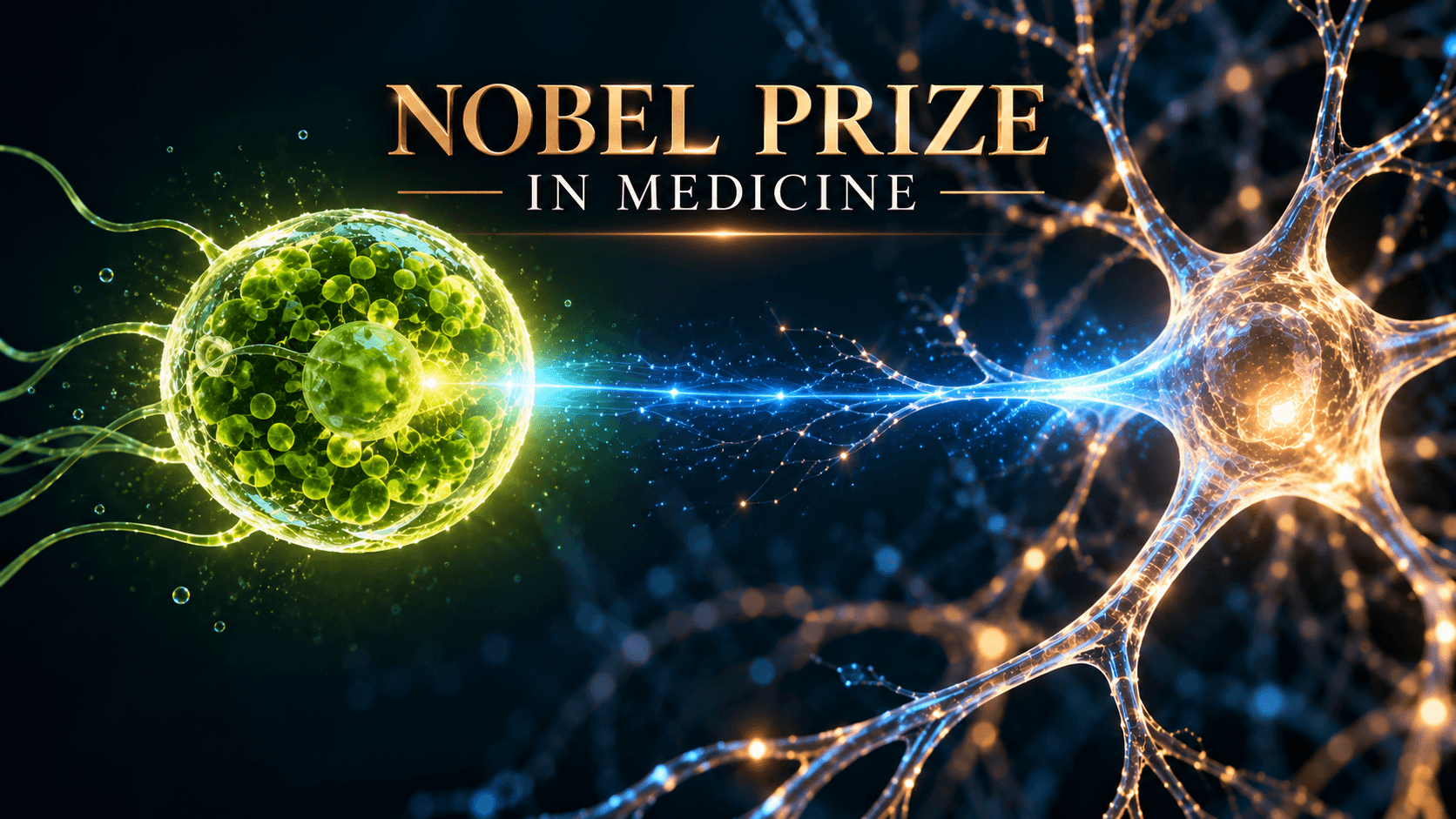
Imagine a sleeping mouse in a laboratory, and a flash of light that makes it wake up.
That is not a thought experiment. Coverage of this year's Nobel Prize in Physiology or Medicine says Karl Deisseroth used light to wake sleeping mice, and that the result showed specific nerve cells control wakefulness.
The surprise is where the switch came from: a brain-cell on-off control was borrowed from an alga that was only reacting to light.
An Alga With a Very Fast Reflex
In the early 1990s, Peter Hegemann was studying how a green alga called Chlamydomonas reacts to light. Coverage of the prize reports that the response takes about half a millisecond.
Hegemann proposed something neat. One protein, he suggested, might do two jobs at once: capture the light and act as an ion channel, a membrane channel that lets charged ions through.
Think of an automatic shop door. Usually the sensor and the door are separate parts. Hegemann was guessing that, in the alga, they were a single piece.
Frog Eggs and a Test
Georg Nagel tested the idea by injecting Chlamydomonas genes into frog eggs. That led to the discovery of channelrhodopsin-2, a light-sensitive ion channel.
A paper that Nagel, Hegemann and colleagues published in 2003 described channelrhodopsin-2 as a directly light-gated channel. It worked not only in frog egg cells but in mammalian cells too, where light switched on a flow of electrical charge. The authors wrote that the protein "may be used to depolarize small or large cells" simply by illumination.
Reports on the prize add that the 2003 work showed the protein could be placed in human and hamster cells and used to trigger electrical impulses with light.
That mattered. A gene taken from an alga could be moved into animal cells, and the cells would respond to light.
From a Dish to a Living Brain
A cell in a dish is not a brain. The next step came in 2005, when Deisseroth, at Stanford, showed the method working in rat nerve cells. A year later the method was given its name: optogenetics.
Deisseroth went on to use it in living animals. Coverage of the prize describes him controlling whisker movements in mice by activating particular nerve cells in the motor cortex.
Thomas Perlmann, secretary-general of the Nobel Assembly, summed up the payoff: researchers can now turn individual nerve cells in a living brain on or off.
Where Deisseroth Came In
Hegemann and Nagel worked out the alga's light-sensitive protein. Deisseroth came to the story from a different direction.
According to coverage of the prize, Deisseroth was then training as a neurosurgeon and met people at a psychiatric clinic whom he had no way to help.
The laureates collect their awards on 10 December, the anniversary of Alfred Nobel's death.
Did You Know?
The three laureates work in two countries. Deisseroth, 54, is at Stanford University, Hegemann, 71, is at Humboldt University of Berlin, and Nagel, 73, is at the University of Würzburg.
What a Switch Lets You Ask
Being able to switch chosen cells on or off lets a researcher ask a sharper question: if only these cells go quiet, what changes?
The Nobel Assembly said the method has fundamentally changed how the brain is understood. Per Svenningsson, who chairs the Nobel committee, said it makes possible a kind of brain mapping that scientists could once only dream of.
Al Jazeera's coverage notes that it helps researchers see what particular kinds of cell add to behaviours such as learning, fear, addiction and movement. Waking from sleep belongs on that list too, and why your brain needs sleep covers the everyday biology on the other side of it.
According to reporting on the prize, it is also being used in animal models of conditions including schizophrenia, Alzheimer's, Parkinson's, epilepsy and addiction.
Notice what that sentence says. These are models in animals. One scientist quoted in the coverage said that finding the active cells in mouse versions of these illnesses shows researchers where to look in humans, and described a new era in neuroscience as having just begun.
The Hard Part: From Mice to Patients
The medical hopes are real but uneven. Researchers hope optogenetics could make cochlear implants more precise by stimulating the auditory nerve more finely than the electrical devices used today. That is a hope, not a demonstrated result.
Vision has a human result. In 2021, researchers reported a 58-year-old man with advanced retinitis pigmentosa who regained some visual function after an optogenetic therapy. The report described a single patient, and the recovery was partial: he could perceive, locate, count and touch objects, but only with the treated eye while wearing light-projecting goggles.
The authors described it as the first time an optogenetic therapy had partly restored function in a neurodegenerative disease. It was the one patient described from an early-phase, open-label trial, so it shows the idea can work in a human eye, not that it works for everyone.
Prize coverage adds that the most advanced commercial efforts, including a retinitis pigmentosa treatment and an autism therapy from MapLight, a company Deisseroth co-founded, are still some distance from reaching patients.
For a different angle on how signals reach the brain from elsewhere in the body, the gut-brain connection is a good companion read.
It is easy to tell the story of this prize as pure application: a clever tool, a better experiment. The more interesting reading is how much of it began with a question about an alga. Hegemann studied how it reacts to light and proposed that one protein might both catch the light and form a channel. Nagel tested that proposal in frog eggs.
There is a caution inside the celebration too. A tool that works in mice has a long way to go before it helps a patient, and the first human result is small and partial. Honest enthusiasm keeps both facts in view.
A brain-cell switch was borrowed from an alga that was only reacting to light.
Knowlegic Perspective
It is easy to tell the story of this prize as pure application: a clever tool, a better experiment. The more interesting reading is how much of it began with a question about an alga. Hegemann studied how it reacts to light and proposed that one protein might both catch the light and form a channel. Nagel tested that proposal in frog eggs.
There is a caution inside the celebration too. A tool that works in mice has a long way to go before it helps a patient, and the first human result is small and partial. Honest enthusiasm keeps both facts in view.
A brain-cell switch was borrowed from an alga that was only reacting to light.
Sources & References
- Nobel medicine prize honours US and German scientists for optogenetics work, Al Jazeera (2026)
- German and US neuroscientists win Nobel medicine prize, TimesLive (2026)
- German, US scientists win Nobel medicine prize for work on optogenetics, Khaleej Times (2026)
- US and German scientists win Nobel medicine prize for work on light and brain, Hawaii Tribune-Herald (2026)
- Channelrhodopsin-2, a directly light-gated cation-selective membrane channel, Proceedings of the National Academy of Sciences (2003)
- Gene Therapy Partially Restored Vision in Patient with Retinitis Pigmentosa, CGTLive (2021)
Enjoyed this?
Get notified when a new Knowlegic story worth knowing is published.


