

If We Detect an Alien Signal Tomorrow, What Happens Next?
The real first-contact plan has surprisingly little to do with aliens and a lot to do with keeping humans from jumping the gun.
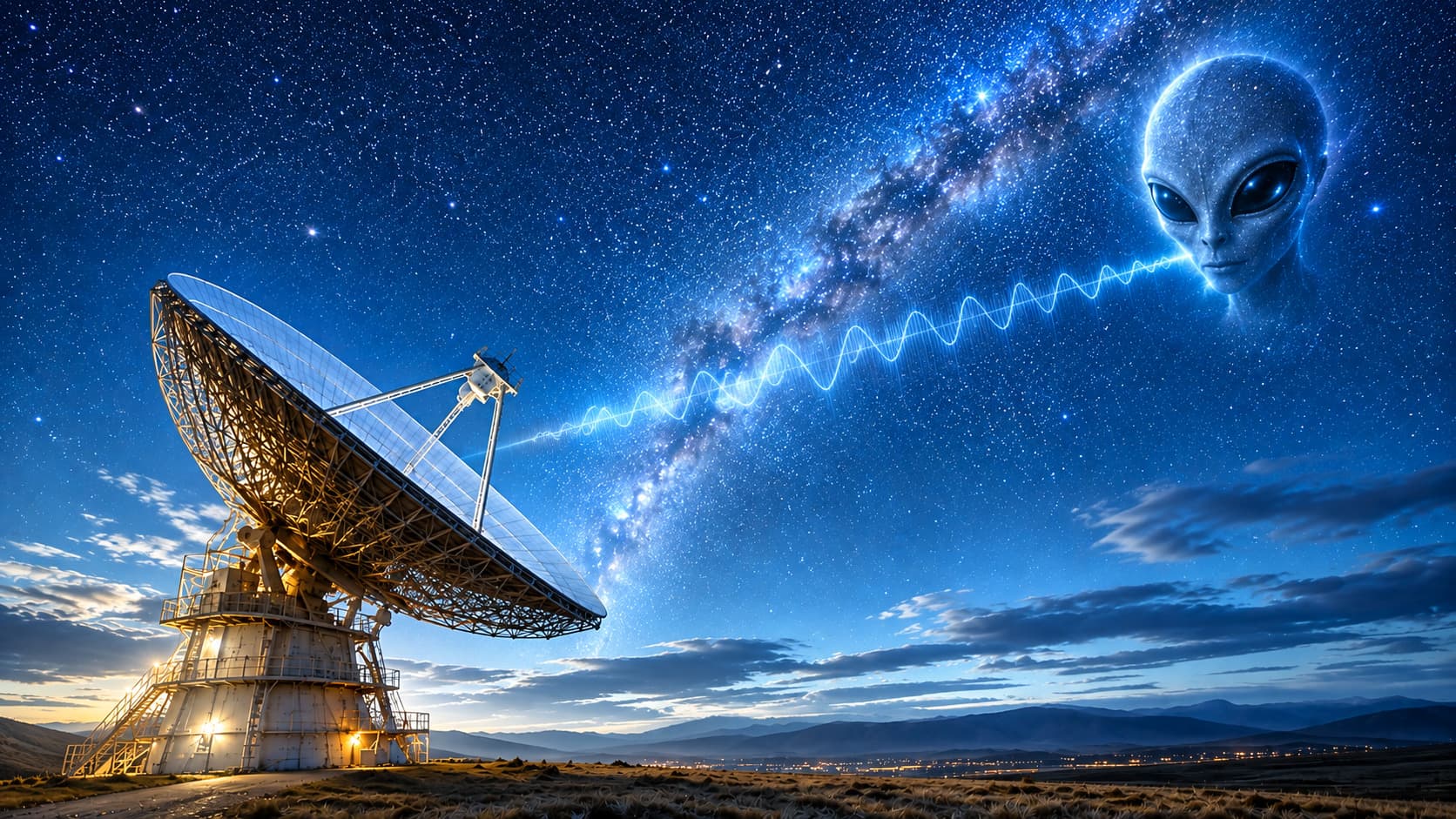
Imagine this headline appearing tomorrow:
Scientists may have detected a signal from an alien civilization.
Within minutes, it would be everywhere.
News alerts. Social media. Videos. AI-generated images. Speculation about what the signal means and who sent it.
But here's the surprising part:
Scientists aren't supposed to immediately announce that they've found aliens.
There is an established international framework for what happens when a potentially artificial signal is detected. And in 2026, that framework was significantly updated for a world where information can spread globally before scientists have finished checking whether the original claim is even true.
The reason isn't hypothetical.
Something very similar has already happened.
We've Already Had the False Alarm
In 2019, a radio telescope in Australia recorded an unusual signal apparently coming from the direction of Proxima Centauri, our nearest stellar neighbor.
Nobody noticed it for more than a year.
When scientists working with Breakthrough Listen identified it in late 2020, the signal looked intriguing. Its frequency appeared to drift in a way that could be consistent with a moving source somewhat like the changing pitch of an ambulance siren as it passes you.
Then the story leaked.
The headlines arrived before the analysis was finished.
The signal became international news.
There was just one problem.
When researchers eventually subjected it to detailed verification, the exciting explanation collapsed.
The signal was traced to interference from human technology.
It wasn't aliens.
It was Earth.
And that episode exposed an increasingly important problem:
The challenge isn't only detecting an unusual signal.
It's making sure the world doesn't mistake an interesting signal for a confirmed discovery before scientists have finished checking it.
This Has Happened Before
BLC-1 wasn't the first time an unusual radio signal created excitement.
1967: The Signal That Looked Almost Too Perfect
Cambridge graduate student Jocelyn Bell Burnell noticed an extraordinarily regular radio pulse repeating every 1.3 seconds.
For a moment, the signal was jokingly labeled LGM-1, short for "little green men."
But Bell Burnell and her colleagues didn't stop at the exciting explanation.
They kept looking.
Soon, they found similar signals coming from other parts of the sky.
That made an extraterrestrial beacon extraordinarily unlikely.
The actual explanation was something entirely new to astronomy:
a pulsar- a rapidly rotating neutron star producing a sweeping radio beam.
The mystery became a scientific discovery rather than an alien announcement.
1977: The "Wow!" Signal
Then came another famous mystery.
In 1977, an Ohio State radio telescope detected a powerful 72-second burst that was dramatically stronger than the surrounding background noise.
The astronomer reviewing the data circled the result and wrote:
"Wow!"
The name stuck.
Unlike the 1967 signal, the Wow! signal has never repeated despite decades of follow-up observations.
Its origin remains debated. A recent analysis has proposed a natural explanation involving cold hydrogen clouds, but the mystery has not been completely settled.
And that's an important distinction:
Unexplained does not mean extraterrestrial.
The Rulebook Is Designed to Slow Things Down
There is a real international framework governing how scientists should respond to a possible detection of extraterrestrial intelligence.
It is called the Declaration of Principles Concerning the Conduct of the Search for Extraterrestrial Intelligence.
First written in 1989 by the International Academy of Astronautics, it has been revised periodically.
In early 2026, the committee approved a major update designed for a very different information environment, one shaped by social media, deepfakes, automated misinformation, and instant global communication.
The central philosophy is remarkably simple:
Slow down. Verify first. Announce later.
Step One: Assume It's Not Aliens
The protocol's approach is almost stubbornly cautious.
A promising signal should initially be treated as something ordinary until the evidence proves otherwise.
Could it be:
-
A satellite?
-
A ground-based transmitter?
-
Instrument interference?
-
A technical malfunction?
-
A known astronomical phenomenon?
Scientists are expected to investigate those possibilities before jumping toward the extraordinary.
That's exactly what happened with BLC-1.
Researchers developed a dedicated verification framework and found that the unusual frequency drift could be linked to interference patterns associated with ordinary electronics on Earth.
When astronomers pointed their telescopes back toward Proxima Centauri, the signal had disappeared.
The universe hadn't called. Our technology had.
Did You Know?
Breakthrough Listen, the project that identified BLC-1, is described in the source article as the most sensitive alien-signal search ever built.
Its ten-year, $100 million program searches roughly a million nearby stars, the plane of our galaxy, and another hundred galaxies using telescopes dramatically more sensitive than earlier SETI efforts.
The better our instruments become, the more unusual signals we are likely to notice.
Which makes verification more important, not less.
The New Problem Isn't the Signal. It's Us.
The most revealing addition to the updated framework may not involve telescopes at all.
The committee is establishing a permanent Post-Detection Sub-Committee involving social scientists, legal scholars, and ethicists.
Its purpose is not to determine whether a signal is real.
Its purpose is to think about what happens to human society after information about a possible detection begins circulating.
That's a subtle but important shift.
The scientific process for checking a signal is already relatively well understood.
The harder question is:
What happens when eight billion people hear a rumor before scientists know what it means?
In the age of deepfakes and instant sharing, a blurry screenshot or misleading headline could travel around the world long before a second telescope has even looked at the sky.
Nobody Gets to Reply Alone
Suppose scientists eventually confirm that a signal really is artificial.
What happens next?
Interestingly, the protocol doesn't give one scientist or even one government the authority to simply answer.
One principle that has remained consistent since 1989 is that sending a response should not be an individual decision.
Any transmission should involve international consultation, specifically through the United Nations.
But there's an important catch.
This isn't international law.
It's a voluntary scientific norm.
There is no treaty forcing every government, company, or wealthy individual to follow it.
That means the protocol's power comes largely from collective agreement rather than enforcement.
And that makes the principle both sensible and fascinating:
Humanity has discussed what to say to an alien civilization before we've even agreed on who gets to speak for humanity.
From Signal to Confirmation
If a genuine candidate signal appears, the process is designed to look less like a Hollywood announcement and more like a scientific investigation:
Detection → Investigation → Independent verification → Confirmation → Public communication
The crucial step is the middle one.
Independent verification.
A signal becomes much more convincing when different teams, using different instruments, can observe the same phenomenon and rule out terrestrial and natural explanations.
The excitement comes first.
The evidence comes later.
The protocol exists to make sure the second one wins.
Knowlegic Perspective
It's tempting to imagine first contact as one dramatic moment:
A signal arrives.
Scientists discover its origin.
The world changes overnight.
The actual plan is much less cinematic.
It's mostly about slowing down.
The history of SETI is filled with near-misses that reveal the same lesson:
A pulsar looked extraordinary until more evidence arrived.
The Wow! signal remains fascinating precisely because it has not repeated.
BLC-1 looked promising until researchers traced its characteristics back to human technology.
Every case reinforces the same principle:
An unexplained signal is a question, not an answer.
If a genuine extraterrestrial signal arrives tomorrow, the first thing humanity may need isn't a translator.
It may be patience.
The protocol's entire philosophy is built around one idea:
Let the process outrun the excitement.
Because the history of possible alien signals has already taught us something important.
A strange signal can come from a neutron star.
It can remain unexplained for decades.
It can even come from a clock oscillator on Earth.
So if the next mysterious signal arrives, perhaps the most important headline won't be:
"We Found Aliens."
It will be:
"Scientists Are Still Checking."
And that might be exactly how a genuine discovery should begin.
Enjoyed this?
Get notified when a new Knowlegic story worth knowing is published.


