

The Secret Pentagon UFO Program Congress Didn't Know It Funded
How Senator Harry Reid quietly funded a Pentagon UFO program, why it stopped in 2012, and how a 2017 investigation brought AATIP back into public view.
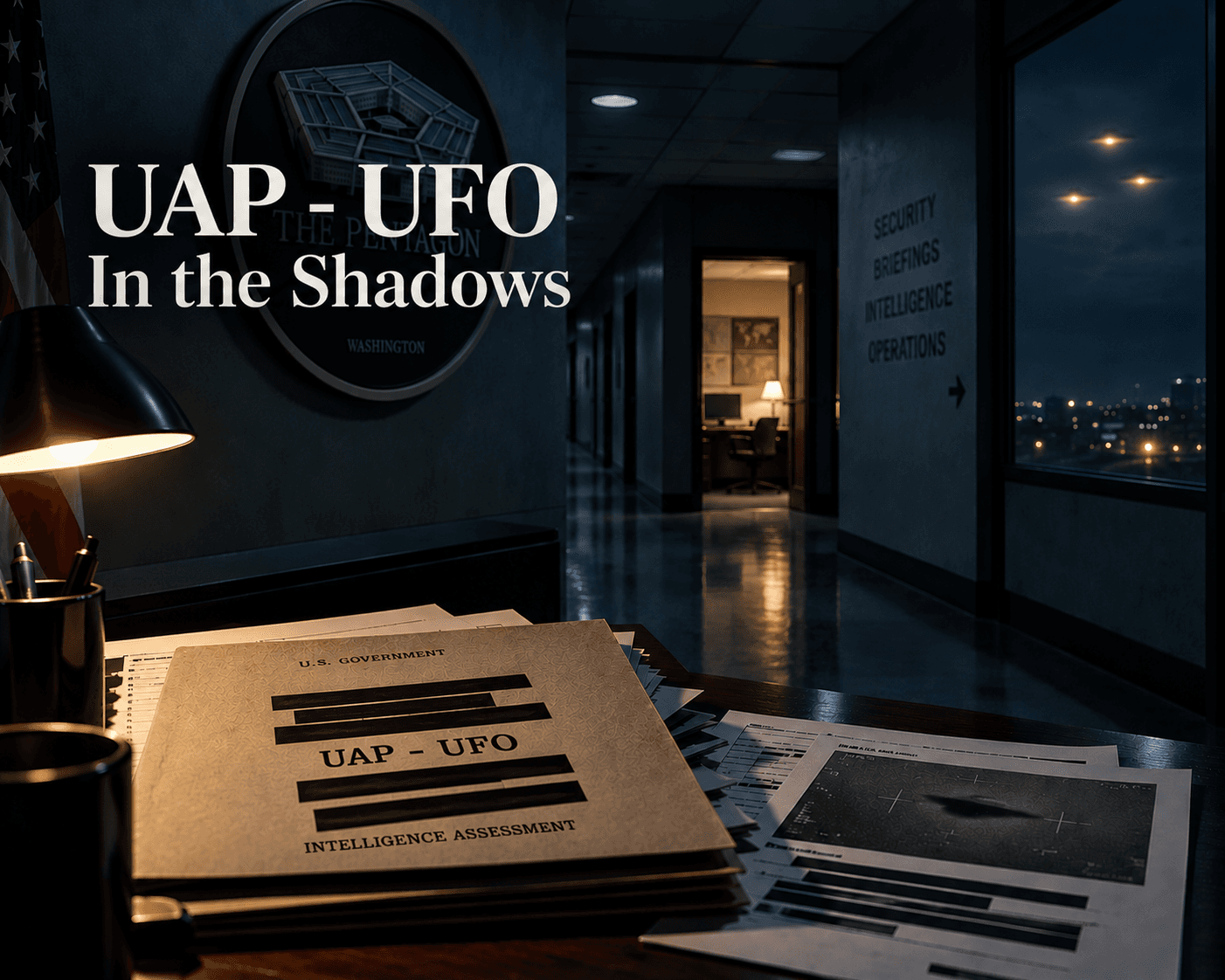
In 2007, a $22 million line item slipped into the defense budget carried no name that meant anything to the people voting on it. It sat buried inside routine appropriations language, the kind that gets waved through by staffers who trust the process to have already done the scrutinizing.
Almost no one scrutinizing it knew it existed. The senator who arranged it never had to explain it on the floor, because earmarks buried in classified annexes don't get debated, they get approved. For half a decade, the Pentagon quietly paid a company run by a hotel magnate to chase reports of aircraft that seemed to defy the laws of aerodynamics.
Nothing about how this money moved was illegal. That is the uncomfortable part. The Advanced Aerospace Threat Identification Program was not a rogue operation or a cover-up in the cinematic sense: it was ordinary Washington procedure, applied to an extraordinary subject, and the secrecy came less from what the Pentagon found than from how awkward the whole thing was to admit to.
A Senator, a Friend, and a Line Item
Harry Reid was the Senate Majority Leader in 2007, one of the most powerful people in Washington, and he had a long-standing fascination with unexplained aerial phenomena. He also had a friend: Robert Bigelow, a Las Vegas hotel and real estate billionaire who had already built an aerospace company, Bigelow Aerospace, and had a private interest in what he believed might be evidence of something beyond human origin.
Reid worked with two fellow senior appropriators, Ted Stevens of Alaska and Daniel Inouye of Hawaii, to route roughly $22 million toward a Defense Intelligence Agency effort over five years. The money did not require a public vote explaining its purpose. It moved the way most defense black-budget items move: approved in classified annexes that rank-and-file members of Congress rarely read line by line.
The initial contract went to Bigelow's research arm, Bigelow Aerospace Advanced Space Studies, under a 2008 program called the Advanced Aerospace Weapon Systems Applications Program. Only one company bid on it: Bigelow's. His team produced dozens of technical reports on topics ranging from exotic propulsion concepts to reports of unusual phenomena at a Utah ranch Bigelow had personally purchased years earlier, and some of that early work folded into what would later be called AATIP.
Running Quietly, Then Running Out
AATIP itself formally operated inside the Pentagon's intelligence apparatus from 2007 to 2012, investigating reports that service members and contractors submitted about aircraft or objects that appeared to move in ways conventional physics couldn't easily account for. It never had the manpower or profile of a major weapons program.
When its dedicated funding lapsed in 2012, the office didn't hold a press conference or issue a report. It simply stopped being funded as a distinct line item, and some of its work reportedly continued informally through people who had been involved, without the earmark that had sustained it.
For five more years, that was effectively the end of the story as far as the public was concerned. No hearings, no leaks, no headlines. The kind of institutional afterlife where a program exists mostly in the private notes of the handful of people who used to run it.
Did You Know?
The 2008 contract that helped seed AATIP's later work drew exactly one bidder. Bigelow's team wrote 38 internal technical reports for the Defense Intelligence Agency, on subjects that ranged from wormhole physics to invisibility cloaking, alongside its aerial-phenomena casework.
A Front-Page Story and a Resignation Letter
On December 16, 2017, The New York Times published "Glowing Auras and 'Black Money': The Pentagon's Mysterious U.F.O. Program," by Helene Cooper, Ralph Blumenthal, and Leslie Kean. It was the story that introduced AATIP to the wider public for the first time, complete with cockpit video the Pentagon later acknowledged was genuine footage from Navy pilots.
The article centered on Luis Elizondo, a former military intelligence official who said he had run the program and had resigned that October in protest of what he described as institutional indifference to the subject. His resignation letter to then-Defense Secretary James Mattis cited "bureaucratic challenges and inflexible mindsets" as his reason for leaving.
The Pentagon's own account complicated that narrative almost immediately. Defense officials stated, in documents later released through public records requests, that Elizondo had no assigned responsibilities related to AATIP during his time in the office he resigned from, a direct contradiction of his public description of himself as the program's director. Neither account has been fully reconciled in the years since, and it remains one of the more genuinely contested details in the program's history, not a settled fact in either direction.
Reid didn't just fund the search quietly, he defended it publicly once it became known. After the 2017 story broke, he told reporters the program had been worth funding and that he was "not embarrassed" by it, a rare instance of a senator owning an earmark most of Congress hadn't known existed.
What the Government Built Next
The 2017 story didn't just revive interest in a defunct program, it triggered an institutional response. In August 2020, the Pentagon formally stood up a new Unidentified Aerial Phenomena Task Force, led by naval intelligence, to formalize a process for collecting and assessing military sighting reports that had previously gone nowhere in particular.
That effort evolved further in 2022, when Congress folded it into a broader office, the All-domain Anomaly Resolution Office, tasked with investigating unexplained phenomena across every branch of the military and coordinating with the wider intelligence community, and required, for the first time, to build a documented historical record of government involvement with the subject going back to 1945.
The Pentagon's inspector general opened its own internal review of how the department had historically handled these reports, separate from AARO's forward-looking mission, an ordinary oversight step that rarely makes headlines but matters more than any single dramatic claim: it's the mechanism that actually checks whether an agency did what it says it did.
That succession, AATIP to the task force to AARO, is where the well-documented history currently stands. In 2023, a former intelligence officer named David Grusch testified before Congress that the government had, for decades, run a secret program retrieving and reverse-engineering crashed craft, and separately alleged the recovery of what he called "non-human biologics." Those are sworn but so far uncorroborated claims: Grusch has said he did not personally witness any of it, investigators have not produced public evidence to confirm it, and AARO's own historical review found no verifiable proof to support it. They remain contested testimony under active congressional review, not an established chapter of this story.
If you're inclined to write the entire subject off as fringe belief, it's worth remembering why the ancient astronaut theory persists even after its central claims were debunked: people don't abandon a compelling story just because the evidence for it is thin. AATIP is the opposite case, a real program with real budget lines and real paper trails, which is exactly why it's worth separating from the speculation that has grown up around it.
Knowlegic Perspective
Strip away the cultural weight the words "UFO program" carry, and AATIP looks like something far more familiar: an earmark, steered by a powerful patron toward a favored contractor, that nobody wanted to explain in public. That's not a uniquely paranormal story. It's a recognizable one, repeated in defense budgets every year, just usually about radar systems or logistics software instead of aerial phenomena.
What makes this case worth remembering isn't proof of anything extraordinary. It's a case study in how institutional secrecy actually works, less a deliberate cover-up of alien contact than a program too embarrassing to defend on the record and too politically protected to kill outright, until its funding simply lapsed on its own.
The government's later moves, standing up a task force in 2020 and a permanent office in 2022, suggest the Pentagon eventually decided that quietly ignoring unexplained reports was itself the bigger institutional risk. Whatever gets found next will have to survive the same scrutiny AATIP eventually did.
The government's cover-up wasn't a conspiracy to hide aliens. It was an earmark nobody wanted to admit funding, and the secrecy that followed had more to do with bureaucratic embarrassment than with anything actually seen in the sky.
Sources & References
- Glowing Auras and 'Black Money': The Pentagon's Mysterious U.F.O. Program, The New York Times (2017)
- Preliminary Assessment: Unidentified Aerial Phenomena, Office of the Director of National Intelligence (2021)
- Whistleblower Testifies U.S. Salvaged 'Non-Human Biologics' From UFO Crash Sites, NPR (2023)
- Secret Pentagon Program Spent Millions To Research UFOs, NPR (2017)
- More Light on Black Program to Track UFOs, Federation of American Scientists, Project on Government Secrecy (2019)
Enjoyed this?
Get notified when a new Knowlegic story worth knowing is published.


