

The Great Pyramid's Engineering Puzzle Nobody Has Fully Solved
Researchers now have strong evidence for how stone reached Giza. How the builders raised millions of blocks remains an open engineering question.
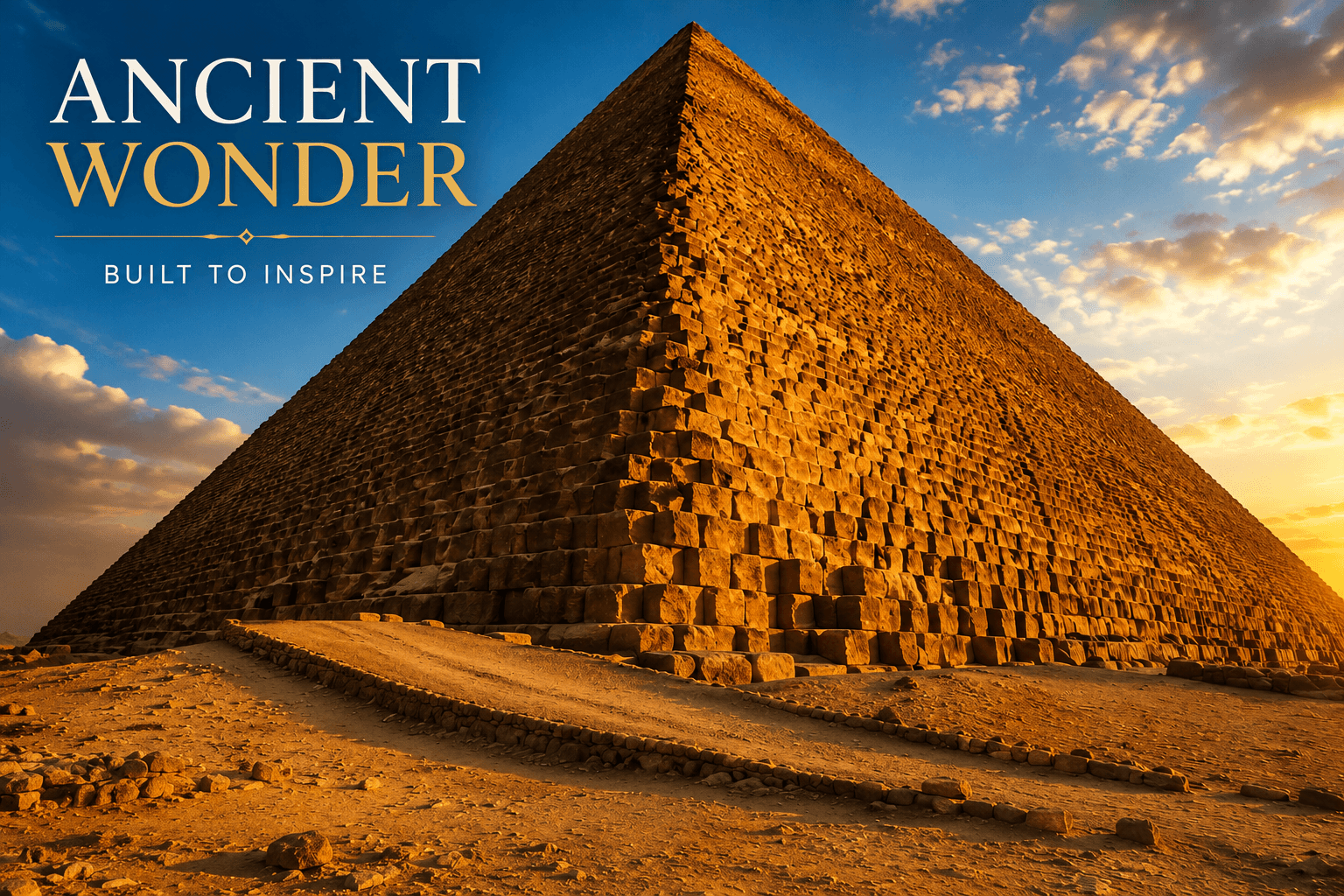
The Great Pyramid of Giza was built with roughly 2.3 million stone blocks, averaging around 2.5 tons each, and originally stood about 481 feet (147 metres) high.
Its builders achieved extraordinary geometric precision using an ancient toolkit of stone, copper, wood and rope.
But one part of the engineering story remains surprisingly unsettled:
How did they get millions of blocks from ground level to the top?
For decades, researchers have proposed ramps, internal pathways, counterweight systems and other combinations.
Recent discoveries have clarified one half of the puzzle.
In 2024, researchers identified evidence for a long-lost Nile branch the Ahramat Branch that ran alongside the pyramid fields and could have provided a waterway for transporting workers and building materials.
Then, in 2025 and 2026, two new computational or engineering proposals added fresh possibilities for how blocks might have been raised.
Neither has been demonstrated as the answer.
And that is what makes the Great Pyramid unusual.
This isn't a mystery that archaeology has abandoned. It is a problem that researchers are still actively testing.
The Part We Just Got Much Closer to Solving: Getting the Stone There
For years, one of the biggest questions was deceptively simple:
How did millions of tons of stone reach the Giza plateau?
The answer increasingly points toward water.
In 2024, a team led by geomorphologist Eman Ghoneim used satellite radar, geophysical surveys and deep soil cores to identify a previously unknown ancient Nile branch.
They named it the Ahramat Branch.
The reconstructed branch stretched about 64 kilometres (40 miles) and was approximately 200–700 metres wide in the sections studied. It ran along the western edge of the Nile floodplain, close to a large concentration of pyramid complexes.
The researchers argue that the branch could have served as a transportation route for construction materials and workers.
That matters because it removes one enormous logistical problem.
Instead of imagining ancient Egyptians dragging every block across kilometres of open desert, boats could have carried material along waterways much closer to the construction sites.
But there is an important distinction.
The Ahramat discovery helps explain where the transportation infrastructure may have been.
It does not tell us exactly how the blocks were raised up the pyramid.
Those are two different engineering problems.
The Diary That Gives Us a Glimpse of the Logistics
There is another extraordinary piece of evidence.
The Diary of Merer, discovered at Wadi al-Jarf in 2013, is a 4,500-year-old administrative record from the reign of Khufu.
Merer was an official who recorded the activities of his work crew, including journeys involving limestone from the Tura quarries.
The papyri mention Akhet-Khufu—“Horizon of Khufu,” the ancient name of the Great Pyramid providing an unusually direct glimpse into the logistics surrounding its construction. (National Geographic)
The surviving records don't provide a construction blueprint.
They don't say:
“Here is the ramp we used.”
But they do reveal something important.
The pyramid was not built through mysterious or improvised labour.
It was a large-scale logistical operation, involving organised crews, boats, quarries, supplies and administration.
The more we learn about the logistics, the less mysterious the transportation side becomes.
The Part Nobody Has Closed: Getting the Stone Up
And now we reach the harder question.
Imagine a block weighing several tons sitting at the base of a pyramid that will eventually rise almost 150 metres.
How do you repeatedly move that block upward?
The simplest proposal is also the oldest:
A ramp.
Workers could place blocks on sledges and pull them up an inclined surface.
The problem is geometry.
A relatively gentle ramp extending all the way to the summit would become enormous.
At an 8% grade, a ramp reaching the original summit would need to extend roughly 1.8 kilometres—far longer than most of the space around the pyramid would comfortably accommodate.
So researchers have proposed variations:
 And none has won universal acceptance.
Jean-Pierre Houdin's Internal Ramp
One of the most famous proposals came from French architect Jean-Pierre Houdin.
His theory suggests that builders used a conventional external ramp for the lower part of the pyramid and then switched to an internal ramp system that spiralled through the structure.
The idea gained attention partly because microgravity surveys detected anomalies inside the pyramid that some researchers interpreted as potentially consistent with an internal structure.
But the theory remains controversial.
The problem isn't simply whether an internal ramp could work.
It is whether the archaeological evidence demonstrates that the Egyptians actually used one.
And that distinction is critical.
A physically plausible reconstruction is not the same thing as an archaeological discovery.
Hatnub Changed What We Thought Was Possible
Then came an important clue from somewhere other than Giza.
At Hatnub, an ancient alabaster quarry, archaeologists discovered a ramp system dating to the reign of Khufu.
It consists of a central ramp flanked by stairways containing numerous postholes.
The researchers suggested that ropes attached to posts could have helped workers haul stone sledges up slopes of 20% or more.
That was significant because it showed that Old Kingdom Egyptians possessed techniques for handling loads on much steeper slopes than some earlier pyramid models assumed.
But there's a catch.
Hatnub is not Giza.
The discovery demonstrates what Egyptian engineers could do.
It does not prove that the same system was used to build the Great Pyramid.
That distinction is easy to lose in popular accounts and extremely important in archaeology.
2025: A Counterweight Proposal
In September 2025, researcher Simon Andreas Scheuring published a very different proposal in npj Heritage Science.
His model suggests that the pyramid's internal architectural features may have functioned as part of a system involving pulley-like mechanisms and sliding counterweights.
Instead of simply dragging blocks upward along a conventional construction ramp, counterweights moving downward could have generated force to help lift blocks.
It is an intriguing engineering model.
But it remains exactly that:
a proposed model.
The paper does not establish that archaeologists have discovered such a system operating at Giza.
This is an important Knowlegic distinction:
A model can demonstrate that something is physically possible without proving that it happened.
2026: Another Model Enters the Debate
And this is where the original article needs its biggest update.
A second major proposal appeared in 2026, not 2025.
Published in npj Heritage Science in March 2026, the Integrated Edge-Ramp (IER) model uses computational modelling to test a multi-ramp system incorporated into the pyramid's own outer edges.
The researchers modelled construction logistics, geometry and structural behaviour and found that their proposed system could theoretically support the required construction pace.
The model also produces testable predictions about what archaeologists might find in the pyramid's masonry if such a system had actually been used.
That's interesting because it changes the nature of the debate.
Instead of simply asking:
“Could this work?”
researchers can begin asking:
“If this worked, what physical traces should still exist?”
That is a much more scientifically useful question.
Four Broad Families of Ideas
The current debate is easier to understand if we stop looking for a single “pyramid ramp theory.”
Instead, there are several broad approaches:
1. External ramps
Blocks are hauled upward along temporary ramps outside the pyramid.
2. Internal ramps
Part of the lifting route is incorporated inside the pyramid.
3. Edge or integrated ramps
The pyramid's own growing structure becomes part of the transportation system.
4. Mechanical or counterweight systems
Mechanical advantage reduces the force required to raise blocks.
There can also be combinations.
And that's important because the Egyptians did not necessarily have to use one method from the first block to the last.
The construction system could have changed as the pyramid grew taller.

Did You Know?
The Great Pyramid's precision creates another mystery.
Its sides are aligned remarkably closely with the cardinal directions.
Research by engineer and archaeologist Glen Dash found the Great Pyramid aligned to true north within roughly one-tenth of a degree, while other studies have proposed different methods for achieving that precision.
One proposed explanation involves using the Sun's shadow around the equinox.
Other possibilities involve astronomical observations.
We therefore have two separate questions:
How did they move the blocks?
and
How did they control the geometry so precisely?
Both remain fascinating and neither has a single universally accepted answer.
Who Actually Built the Pyramid?
One myth can be safely retired.
The evidence does not support the popular image of the Great Pyramid being built primarily by masses of slaves.
Modern archaeological evidence points toward an organised workforce of Egyptian labourers and specialists, with estimates of the active workforce varying considerably. Some modern estimates place the workforce at roughly 20,000–30,000 people, while the exact number remains uncertain.
Herodotus, writing more than two millennia after Khufu's reign, reported a workforce of 100,000 men.
That figure should therefore be treated as an ancient account, not a modern census.
What is increasingly clear is that the project required something more sophisticated than brute strength:
food supply + quarrying + transport + engineering + surveying + administration + labour organisation.
The pyramid was not simply a pile of stones.
It was a state-scale engineering project.
Why Two Mysteries Became One
Perhaps the most useful way to think about the entire debate is to split the famous question:
“How were the pyramids built?”
into smaller questions.
Question 1
How did the materials reach Giza?
Answer:
We now have strong evidence for an ancient water-based transport network, including the Ahramat Branch, combined with the documentary evidence from Merer's diary.
Question 2
How were blocks moved around the construction site?
Answer:
Several plausible logistical systems have been proposed.
Question 3
How were millions of blocks raised toward the summit?
Answer:
Still unresolved.
Question 4
How was the structure surveyed and aligned so precisely?
Answer:
Several competing explanations exist, but no single method has been conclusively demonstrated.
Separating these questions makes the mystery much clearer.
The Ramp-Length Problem
A straight ramp sounds simple until you draw it to scale.
Great Pyramid
≈ 481 ft high
↓
8% slope
↓
≈ 1.8 km ramp
The problem becomes immediately obvious.
The lower the slope, the longer the ramp becomes.
The steeper the ramp, the harder it becomes to move heavy loads.
So the engineering challenge isn't merely:
“Build a ramp.”
It is:
Build a ramp or lifting system, that is steep enough to be practical, long enough to work, strong enough to carry enormous loads, and adaptable as the pyramid gets higher.
That is the real puzzle.
Knowlegic Perspective
It's tempting to want one elegant answer to:
“How did the Egyptians build the Great Pyramid?”
But that's not how active research usually works.
A discovery doesn't necessarily solve an entire mystery.
It may solve one layer of it.
The Ahramat Branch dramatically improves our understanding of the transportation environment.
Merer's diary gives us a rare administrative record from the period.
Hatnub demonstrates that Egyptian engineers could handle steep inclines using sophisticated rope-and-sledge techniques.
And the 2025 and 2026 models show that researchers are still testing entirely different ways of converting force into upward movement.
None has yet produced the equivalent of a construction manual from Khufu's builders.
And that is precisely why this remains interesting.
Science doesn't always move from mystery → answer.
Sometimes it moves:
Mystery → evidence → competing models → better evidence → narrower possibilities.
The stone's journey to Giza is no longer the blank page it once was.
We have a vanished river.
We have ancient administrative records.
We have quarry evidence.
We have increasingly sophisticated computer models.
But the final climb from the ground to the summit still lacks a universally accepted reconstruction.
And perhaps that's the most fascinating part.
The Great Pyramid isn't an ancient engineering problem waiting for one clever person to solve it.
It is a 4,500-year-old hypothesis that keeps getting tested by new evidence.
The next discovery may come from a forgotten quarry, a buried harbour, a new scan or a mathematical model that predicts a physical trace archaeologists can actually find.
Until then, the pyramid keeps its biggest construction secret.
We know much more about where the stones came from and how they travelled.
We still don't know exactly how the last great climb was done.
Sources & References
Construction of the Great Pyramid with pulley-like systems using counter-weights on sliding-ramps
Ancient quarry ramp system may have helped workers build Egypt's Great Pyramids
A Ramp Contraption May Have Been Used to Build Egypt's Great Pyramid.
Ancient Nile Tributary May Have Aided Pyramid Construction
Scientists find evidence of ancient waterway beside Egypt's pyramids
On Jean-Pierre Houdin's internal ramp theory and its critics
Is the Fall Equinox the Secret to the Pyramids' Near-Perfect Alignment?
The Secret of The Pyramids' Perfect Alignment Might Be Explained After All
Enjoyed this?
Get notified when a new Knowlegic story worth knowing is published.


