

The Undersea Chokepoints the Whole Internet Depends On
Almost every message that crosses an ocean travels down a few hundred fragile cables, and those cables crowd through a handful of narrow places where a single dragged anchor can slow the internet for an entire region.
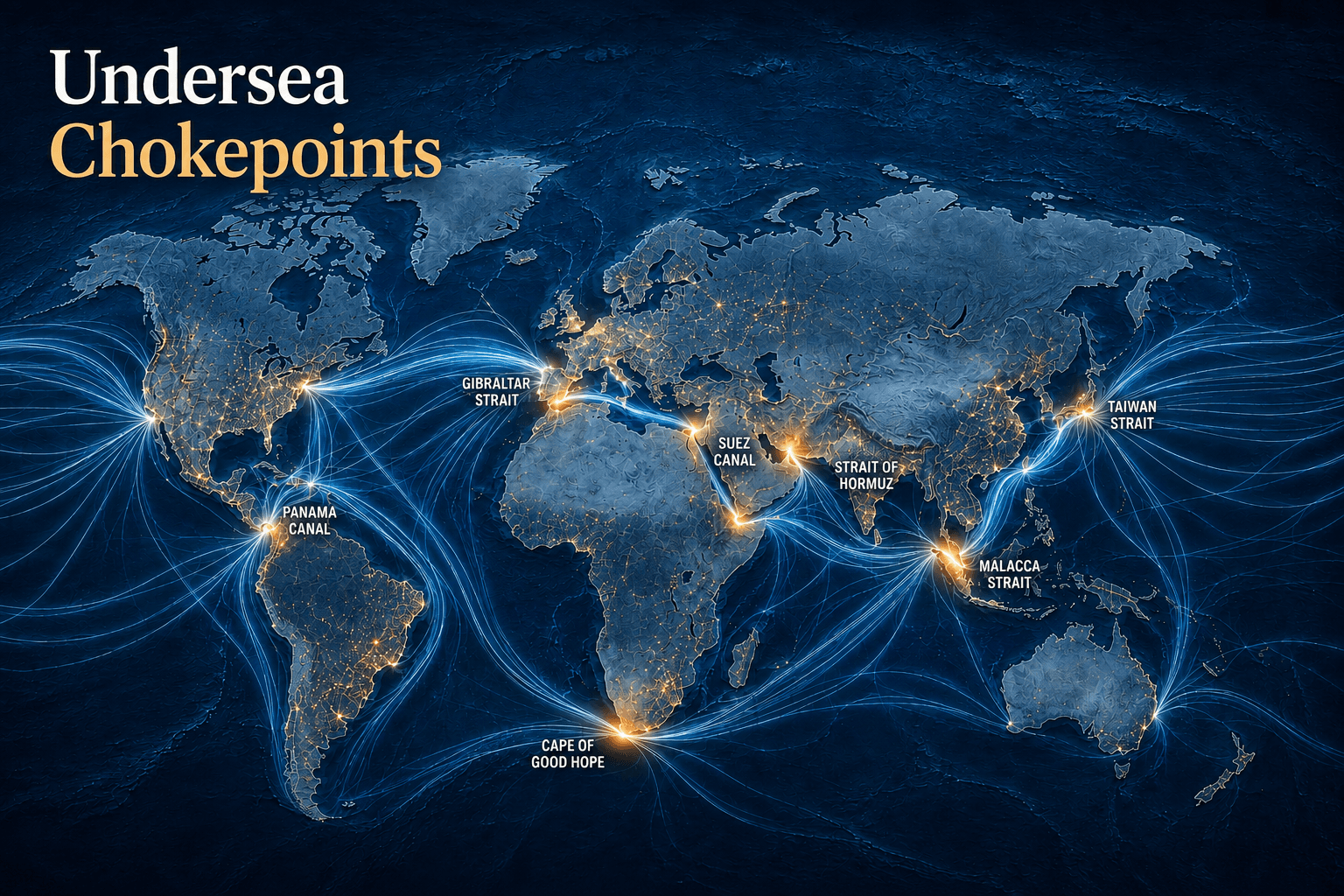
On a September morning in 2025, engineers at Microsoft noticed that data between Asia and Europe had started taking the long way around. Traffic that normally slipped through the Red Sea was now being pushed across the Pacific and the Atlantic instead, and customers as far away as India and the United Arab Emirates felt their connections lag.
The cause was two severed cables on the seabed near Jeddah, in a stretch of water only a few dozen miles wide. Nobody had to attack a data center or hack a network. Something heavy touched the bottom of the sea in exactly the wrong place.
Almost everything the world sends across an ocean rides a few hundred fragile cables, and those cables squeeze through a handful of narrow places where one bad day on the seabed can dim the internet for a continent.
The Cloud Has a Coastline
Start with a number that sounds made up but is not far off: by most estimates, around 99% of the data that crosses between continents travels through undersea cables rather than satellites. TeleGeography, the research firm that maps this network, is careful to note that nobody can calculate the exact figure because satellite traffic is not fully reported. Still, every serious analysis lands in the same place. The cables carry the overwhelming majority, and satellites handle a rounding error.
The reason is cost. Moving a unit of data through a modern cable is thousands of times cheaper than moving it by satellite, so the world built cables. There are now roughly 500 active systems in service, a web of glass strands stretching well over a million kilometers along the ocean floor. If you want the full picture of how this hidden layer got built and how the light actually travels, we have a companion explainer on the world of submarine cables.
Here is the part people miss. That web is not spread out. It is knotted.
Why the Map Bunches Up
Cables follow the same logic as roads. You lay them along the shortest safe path between the places that need connecting, you avoid deep trenches and earthquake zones, and you land them where a country will give you a permit and a building for the equipment. Do that a few hundred times and the routes start to overlap.
The result is a set of chokepoints that look a lot like the ones oil tankers worry about. The narrow waterways that concentrate the world's shipping tend to concentrate its data too, for the same reason: the coastlines leave no other way through.
The Red Sea and the Bab-el-Mandeb strait funnel the traffic between Europe and Asia. By common industry estimates, well over 90% of Europe-to-Asia cable capacity runs through this one corridor. The Luzon Strait between Taiwan and the Philippines carries the bulk of the traffic in and out of East Asia. The approaches to the Strait of Malacca gather up South and Southeast Asian routes. The English Channel and the Baltic do the same for northern Europe. In each case, dozens of cables share a piece of water you could cross in an afternoon.
The Land Bridge That Carries the Internet
The strangest chokepoint is not water at all. It is Egypt.
To get from the Mediterranean to the Red Sea, a cable cannot go around Africa without adding thousands of miles. So instead it comes ashore on Egypt's north coast, runs across the country through buried terrestrial ducts, and dives back into the sea near Suez. Something like 16 cable systems make this crossing, and by some estimates close to 17% of the world's internet traffic passes over that one narrow strip of land.
This is not a new vulnerability. In early 2008, cable breaks near Alexandria knocked out large parts of the internet across the Middle East and India for days, and slowed connections as far away as Southeast Asia. The route has more cables now, but they still walk through the same door.
Did You Know?
When cables broke in the Luzon Strait after a magnitude-7 earthquake off Taiwan in December 2006, nine systems failed almost at once. Banks, airlines, and phone networks across China, Hong Kong, Japan, Singapore, and the Philippines were disrupted for weeks while a small fleet of repair ships worked through a queue of breaks in one patch of sea.
A Bad Two Years on the Seabed
For a long time this was mostly a story about accidents. Roughly 150 to 200 cable faults happen worldwide every year, and around 70 to 80% of them are caused by fishing gear or ships' anchors dragging across the bottom. Most never make the news because traffic reroutes automatically and nobody notices.
The recent run of incidents is harder to wave away because so many landed on chokepoints at once.
In February 2024, three cables were severed in the Red Sea, most likely by the anchor of the Rubymar, a cargo ship that had been hit by a missile and was drifting, abandoned, through a field of cables before it sank. That single event disrupted an estimated quarter of the traffic between Asia, Europe, and the Middle East.
In November 2024, two cables in the Baltic Sea were cut within a day of each other. Investigators tracked a Chinese-flagged bulk carrier, the Yi Peng 3, that appeared to have dragged its anchor along the seabed for more than a hundred miles. A Swedish investigation later said it could not determine whether the damage was deliberate or an accident.
Around Taiwan, the pattern is denser still. Authorities there recorded cable damage from passing ships repeatedly through 2023, 2024, and 2025, and in June 2025 a Chinese ship's captain was sentenced to three years in prison for intentionally severing a cable, the first such conviction in Taiwan. When two cables to the Matsu Islands were cut in early 2023, days apart, the islands' roughly 14,000 residents spent weeks on a slow backup connection while they waited for a repair ship to become available.
The world has only about 60 ships capable of laying and repairing undersea cables, and the average one is around 25 years old. Over the past decade, roughly eight new cable ships were built. The fleet fixing the backbone of the global internet is smaller than the number of cruise ships operated by a single large holiday company.
Why Nobody Can Just Fix It Faster
When a cable breaks, a specialized ship has to sail to the site, find the fault, grapple the cable up from the seabed, cut out the damaged section, splice in a new piece, and lower it back down. In deep water this takes days. In a contested area it can take much longer, because the ship needs permits, insurance, and sometimes a naval escort.
The joint advisory body on cable resilience set up by the International Telecommunication Union and the International Cable Protection Committee has reported that the average time to start a repair roughly doubled between 2012 and 2024, from under 20 days to more than 50. The number of breaks did not rise much. The ability to respond did not keep up, held back by an aging fleet, slow permitting, and taxes and rules written for other kinds of shipping.
Redundancy is the industry's answer, and it genuinely helps. A big economy connected by 15 cables barely notices losing one. But redundancy is unevenly distributed. Island territories and single-cable countries have none to spare, and even well-connected regions run into trouble when several cables in the same chokepoint fail together, because the spare capacity was supposed to be in exactly the corridor that just went down.
What Rerouting Actually Looks Like
For a user, a major cable cut usually feels like a slow afternoon, not a blackout. Video calls stutter, cloud apps hesitate, a website in another hemisphere takes a beat longer to load. The traffic has found a longer path, and longer paths mean more delay.
For a bank running automated trades, or a hospital pulling records from a data center abroad, that added delay is a real operational problem. And the cables are only one link in a chain that also includes the power-hungry data centers at each end. The internet is resilient in the way a city's road network is resilient. Close one bridge and everyone still gets home, just later and by a worse route. Close three bridges in the same district and the whole area seizes up.
Knowlegic Perspective
It is tempting to read the recent cable cuts as a purely geopolitical story, a new front in a contest between states. Some of them may be exactly that. But the more durable point is structural, and it would be true even in a world at peace.
The internet was optimized for cost and speed, and optimization concentrates things. The cheapest routes are the shared routes, the shared routes run through the narrowest water, and the narrowest water is where a network becomes a target, whether the threat is a hostile navy, a drifting derelict, or a fishing trawler with a heavy net. The same logic that makes the system efficient makes it brittle in a few specific places. Spreading the risk out again costs money that no single company has a strong incentive to spend.
Almost everything the world sends across an ocean rides a few hundred fragile cables, and those cables squeeze through a handful of narrow places where one bad day on the seabed can dim the internet for a continent. The network looks like a cloud. It behaves like a set of bridges, and the world has been quietly discovering how few of them there really are.
Sources & References
- Do Submarine Cables Account For Over 99% of Intercontinental Data Traffic?, TeleGeography (2023)
- Statistics on Subsea Cable Fault and Repair, Submarine Networks (2025)
- Submarine Cables Face Increasing Threats Amid Geopolitical Tensions and Limited Repair Capabilities, Recorded Future / Insikt Group (2025)
- The cable ship capacity crunch, Data Center Dynamics (2024)
- What Caused the Red Sea Submarine Cable Cuts?, Kentik (2024)
- The Strategic Future of Subsea Cables: Egypt Case Study, Center for Strategic and International Studies (2025)
- Taiwan suspects Chinese ships cut islands' internet cables, The Washington Post (2023)
- Chinese ship captain handed 3-year sentence over severed telecoms cable, Focus Taiwan / Central News Agency (2025)
Enjoyed this?
Get notified when a new Knowlegic story worth knowing is published.


