

The History of FIFA: From Seven Founding Nations to a Global Football Empire
How a small football federation became the organization behind the world's biggest sporting event.
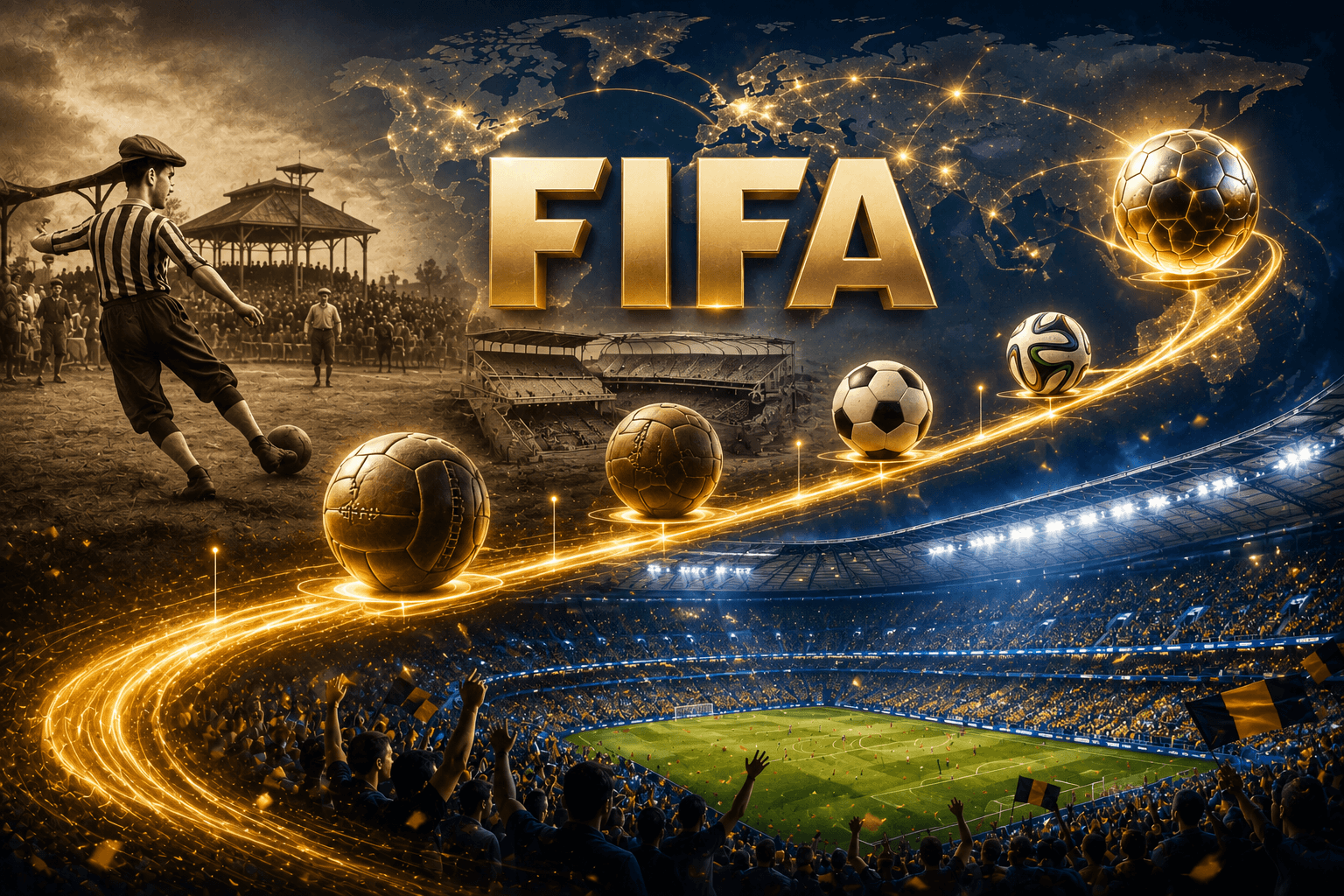
Today, FIFA governs football across 211 member associations, more than the number of member states in the United Nations and oversees the FIFA World Cup, one of the world's most watched sporting events.
But FIFA didn't begin as a commercial powerhouse.
Founded in Paris in 1904 by just seven European football associations, its original purpose was simply to standardize the rules of an increasingly international game. Over the next century, FIFA evolved through expansion, commercialization, controversy, and global growth to become one of the most influential organizations in sports.
This article explores the milestones that shaped FIFA's remarkable journey from its humble beginnings to its transformation into a multi-billion-dollar institution.
A Small Meeting That Changed Football Forever
Modern football was born in England.
Yet when representatives from seven European football associations gathered in Paris in 1904 to establish an international governing body for the sport, England wasn't in the room.
At the time, England's Football Association believed it already held sufficient authority over the game and saw little need for another organization.
History would prove otherwise.
Within just two years, England joined the new federation after realizing that international football needed a common set of rules and an organization capable of coordinating competitions across national borders.
What began as a meeting of seven associations would eventually grow into an institution overseeing football in 211 member associations, organizing the world's largest sporting tournament, and generating billions of dollars in revenue.
The journey from a rule making federation to a global sports powerhouse is one of the most fascinating stories in modern sport.
FIFA's Journey at a Glance

Founded by Everyone Except the Country That Invented the Game
FIFA was officially founded on 21 May 1904 in Paris under the leadership of French journalist Robert Guérin, who became its first president.
The founding members were:
- France
- Belgium
- Denmark
- Netherlands
- Sweden
- Switzerland
- Spain
Notice who's missing?
England.
Despite being regarded as the birthplace of modern football, England initially chose not to participate.
However, once it became clear that international football required a unified governing body, England joined FIFA within two years.
That decision marked the beginning of FIFA's transformation into a truly global organization.
Although England created the modern rules of football, it wasn't one of FIFA's original founding members. It joined later after recognizing the importance of an international governing body.
The World Cup Didn't Exist for FIFA's First 26 Years
Today it's almost impossible to imagine FIFA without the World Cup.
But for more than two decades after its founding, FIFA had no flagship tournament.
Instead, international football remained closely linked to the Olympic Games.
Everything changed under Jules Rimet, one of FIFA's most influential presidents.
Rimet believed football deserved its own global championship, one independent of the Olympics.
His vision became reality in 1930, when Uruguay hosted the very first FIFA World Cup.
Only 13 nations participated.
Uruguay defeated Argentina 4–2 in the final to become football's first world champion.
The tournament laid the foundation for what would become the most prestigious competition in international football.
The original Jules Rimet Trophy was stolen twice during its history. It was famously recovered in England in 1966 by a dog named Pickles, but after being stolen again in Brazil in 1983, it was never recovered.
The President Who Turned FIFA into a Global Business
For much of its early history, FIFA focused primarily on organizing football.
That changed dramatically in 1974.
Brazilian sports administrator João Havelange became FIFA president with a bold vision.
Rather than simply governing the sport, he wanted FIFA to become a commercially powerful global organization.
His leadership transformed football in several important ways:
- Expanded the FIFA World Cup
- Increased investment in football development
- Brought greater representation to emerging football nations
- Introduced large-scale commercial sponsorships
- Expanded television broadcasting opportunities
Perhaps his most significant achievement was helping create FIFA's modern commercial model.
Working alongside major corporate partners, FIFA began generating substantial revenue through sponsorships, media rights, and global marketing agreements.
This marked the beginning of FIFA's evolution from a sporting federation into one of the world's most successful sports businesses.
Did You Know?
Before the 1970s, FIFA was primarily known for regulating football. The commercialization introduced during João Havelange's presidency fundamentally changed how international sports organizations generated revenue.
Visual Thinking
From Governing the Game to Building a Global Business

This transformation explains why FIFA today is not only a governing body but also one of the most commercially successful organizations in global sport.
Women's Football Finally Took the Global Stage
For much of FIFA's history, the World Cup was exclusively a men's tournament.
That changed in 1991, when FIFA organized the first Women's World Cup in Guangdong, China—61 years after the inaugural men's tournament.
The United States won the first title, defeating Norway 2–1 in the final.
Although women's football had long existed in many countries, FIFA's decision to launch a dedicated global tournament marked an important turning point.
Since then, the Women's World Cup has grown rapidly in popularity, attracting larger audiences, greater investment, and expanding opportunities for female athletes around the world.
The tournament's growth also reflects how football itself has become more inclusive and globally representative over time.
When Success Brought Greater Scrutiny
As FIFA expanded commercially, so did the expectations placed upon it.
Its growing influence over broadcasting rights, sponsorships, and World Cup hosting decisions made governance more important than ever.
In May 2015, that influence came under intense global scrutiny.
Swiss authorities, acting on requests from the United States Department of Justice, arrested several senior football officials at a hotel in Zurich as part of a wide ranging corruption investigation involving allegations of bribery, wire fraud, and money laundering.
The investigation focused on conduct spanning many years and prompted one of the biggest governance crises in FIFA's history.
Just days later, then-president Sepp Blatter announced that he would step down, opening the door to significant reforms within the organization.
From Seven Members to a Truly Global Organization
When FIFA was founded in 1904, only seven football associations were members.
Today, that number has grown to 211 member associations.
Remarkably, FIFA has more members than the United Nations, which has 193 member states.
Why?
Because FIFA membership includes football associations from territories and regions that are not universally recognized as sovereign nations.
This illustrates football's unique ability to transcend political boundaries.
From small island nations to some of the world's largest countries, FIFA's reach now extends to almost every corner of the globe.
That extraordinary growth explains why the FIFA World Cup has become one of the most watched sporting events in history.
Why It Matters
FIFA is far more than the organizer of the FIFA World Cup.
Its decisions influence broadcasting rights, sponsorship deals, infrastructure investment, tourism, national prestige, youth development, and the global growth of football.
Every four years, the World Cup generates economic activity that extends far beyond the stadiums, benefiting airlines, hotels, broadcasters, sponsors, retailers, and host cities.
Understanding FIFA's history also helps explain how modern sports evolved into global businesses where governance, finance, media, and culture are closely connected.
Football may be played on the pitch.
But the institution behind it shapes an industry worth billions of dollars.
Knowlegic Perspective
FIFA's history is about much more than football.
It is the story of how a small organization created to standardize the rules of a sport gradually became one of the world's most influential institutions.
Over more than a century, FIFA evolved from managing football matches to shaping broadcasting rights, sponsorship markets, infrastructure investment, and global sporting culture.
Its journey also demonstrates an important lesson about institutions:
As organizations grow in influence, they also face greater expectations for transparency, accountability, and good governance.
Understanding FIFA means understanding not only the world's most popular sport, but also how leadership, business, and global cooperation can transform a simple idea into an institution that reaches billions of people.
Enjoyed this?
Get notified when a new Knowlegic story worth knowing is published.


