

The Mountain Lakes That Are Turning Into Time Bombs
High in the world's mountains, melting glaciers are leaving behind lakes held back by nothing but loose rubble and when one lets go, the water arrives as a wall.
At around nine in the morning on a Wednesday in late August 2026, the Bhote Koshi river on the Nepal–Tibet border stopped behaving like a river. In minutes it rose into a churning wall of water and debris that swept away villages, roads and dozens of bridges, and carried people more than a hundred kilometres downstream.
There had been no cloudburst over the valley that morning, no dam failure in the usual sense. The water came from higher up, where a mass of ice and rock had crashed off a glacier, briefly blocked a small stream, and then released everything it had piled up in one violent push.
That is the signature of a glacial lake outburst flood: a disaster built slowly, over years, by a melting glacier, and then delivered all at once. It is a bill for a warming climate that comes due in a single afternoon.
The Puddle a Glacier Leaves Behind
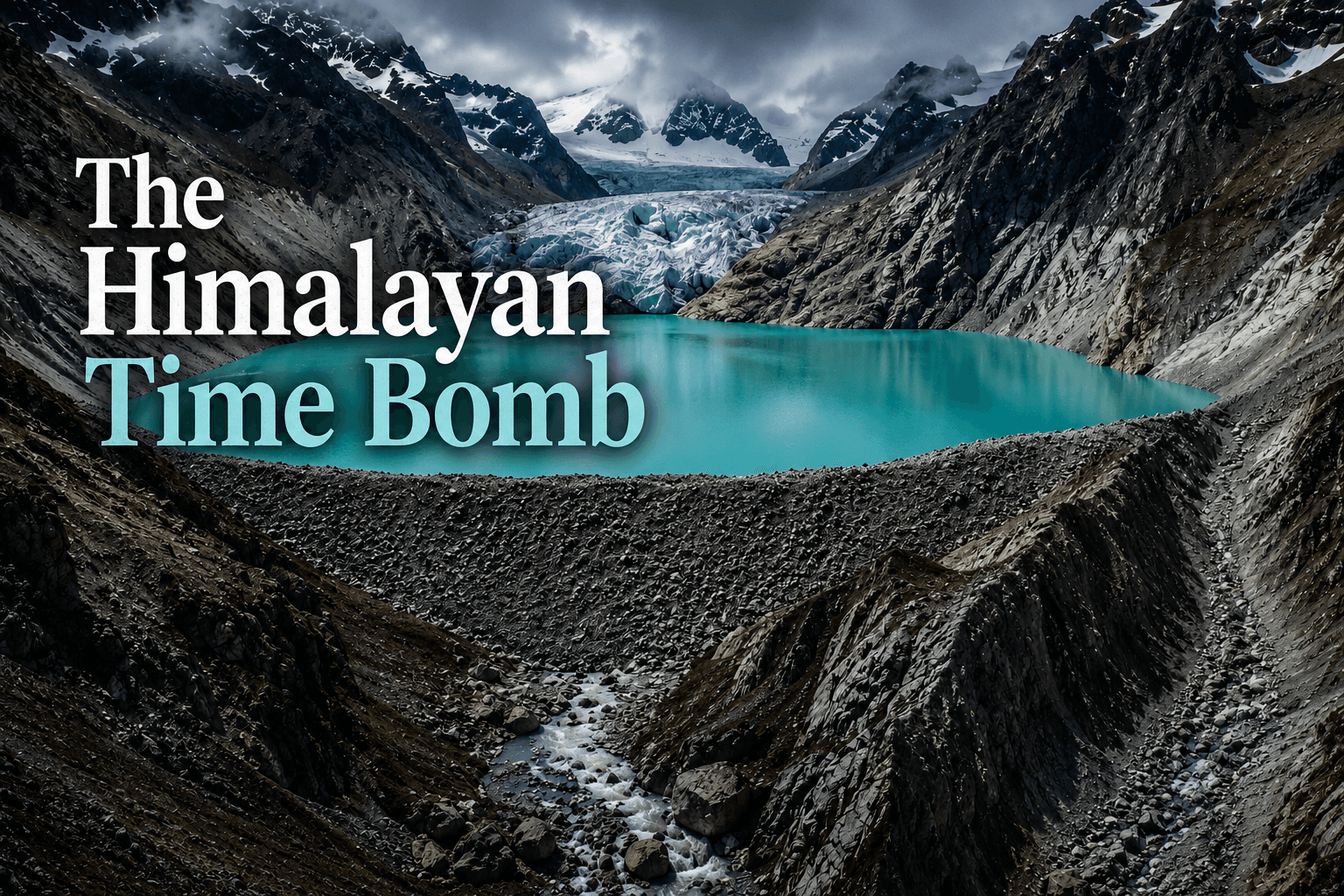
Picture a glacier as a slow conveyor belt of ice grinding downhill. As it moves, it bulldozes rock and grit into long ridges along its sides and snout, the way a plough throws soil into a bank. These ridges are called moraines.
When the climate warms and the glacier retreats, it pulls back from those ridges and leaves a hollow behind. Meltwater fills the hollow. Now there is a lake sitting in a bowl, and the downhill wall of that bowl is a heap of loose, unconsolidated rubble not bedrock, not engineered concrete, just debris.
Most of the time the wall holds. The danger is a sudden shove. A chunk of glacier calves into the lake, or a landslide crashes down from the slopes above, and the displaced water sends a wave over the rim. Once water starts pouring over a pile of loose rock, it carves a channel, the channel widens fast, and within hours the lake can empty almost completely.
What makes the result so destructive is the terrain. The flood starts high in steep, narrow valleys, so gravity does most of the work, and the water picks up boulders and trees on the way down until it is less a flood than a fast-moving river of concrete. It can travel far. In the 2026 Bhote Koshi event, the surge was still tearing out bridges in districts well downstream of where it began.
Did You Know?
The first glacial lake outburst flood to draw serious international attention in the Himalayas hit Nepal's Khumbu region in 1985, when the Dig Tsho lake burst and the flood wave destroyed a nearly finished hydropower plant near the Everest trekking route. Small hydro schemes, roads and bridges are often built along exactly the valleys these floods run down, which is part of why the damage bills are so high.
The Ice Is Leaving More of These Behind Every Year
Glacial lakes are not new, but there are far more of them than there used to be. One global survey using hundreds of thousands of satellite images found that the total volume of water held in glacial lakes grew by roughly half between 1990 and 2018, as glaciers worldwide thinned and pulled back.
The Hindu Kush Himalaya- the arc of high mountains stretching across Afghanistan, Pakistan, India, Nepal, Bhutan and China has thousands of these lakes, and researchers there have flagged a few hundred as potentially dangerous, meaning they are large, unstable, and have vulnerable communities downstream. The same mountains feed the rivers that hundreds of millions of people rely on, which is why the slow squeeze that glacier loss puts on South Asia's water supply and the sudden violence of an outburst flood are really two ends of the same problem.
Globally, a 2023 study led by Newcastle University estimated that about 15 million people live within range of a potential glacial lake outburst flood, with more than half of them in just four countries: India, Pakistan, Peru and China.
When It Goes Wrong at Scale
Two recent disasters show what the worst case looks like.
In October 2023, a large slab of frozen soil collapsed off the side of South Lhonak lake in the Indian state of Sikkim. It hit the water like a dropped brick in a bathtub, throwing up a wave around 20 metres high that overtopped the moraine and drained tens of millions of cubic metres of water in minutes. The flood destroyed bridges and roads down the Teesta valley and collapsed a large hydropower dam more than 60 kilometres downstream. Dozens of people were killed, many more went missing, and tens of thousands were affected.
In August 2024, a rock avalanche above the village of Thame, in Nepal's Everest region, pushed two small glacial lakes over their edges at once. There were no deaths, the village had time to move to higher ground, but the flood wiped out homes, a school and a health post, and carried debris far down the valley.
The 2026 Bhote Koshi flood appears to fit the same pattern. Scientists analysing the seismic records concluded the shaking was caused by a large ice-and-rock avalanche coming down, not by an earthquake setting one off. The same stretch of river had already flooded once the previous year.
Interesting Fact: A glacial lake outburst flood can outrun the news of itself. The water moves down-valley faster than phone calls and official warnings travel between remote mountain districts and the towns downstream, especially when the flood has already knocked out roads, power lines and cell towers on its way. Closing that gap getting a warning to arrive before the water does is the central goal of every early-warning system built for these floods.
Defusing the Ones We Can Reach
The encouraging part is that these are, to a degree, an engineerable hazard.
The most direct fix is to lower the lake. At Imja Tsho, one of Nepal's fastest-growing glacial lakes, engineers cut a controlled channel through the moraine and dropped the water level by a few metres, easing the pressure on the natural dam. Nepal had already done something similar years earlier at Tsho Rolpa, and Bhutanese teams have drained dangerous lakes largely by hand, hauling rock in one of the harshest work environments on Earth.
The other half is warning systems. In the villages below Imja, that means sensors on the lake, automated sirens wired into the settlements downstream, and phone alerts backed by marked evacuation routes, drills, and shelters on high ground that residents have walked to before, in daylight, when nothing was wrong. The design assumption is bleak but realistic: when a flood comes, people may have only minutes, and the siren has to mean something they can act on without thinking.
That model is hard to copy at scale. It was built for one lake, with years of international funding and a local population small enough to train household by household. Most dangerous lakes have none of that.
None of this is cheap or fast, and there are far more dangerous lakes than there are funded projects to deal with them. Many sit on borders, so a lake in one country threatens villages in another, which turns an engineering question into a diplomatic one. The pattern that recurs in the post-mortems Sikkim in 2023 is the clearest case is that the science identified the risk years in advance, and the monitoring and defences simply were not built in time.
Knowlegic Perspective
Glacial lake outburst floods sit in an awkward category of risk: rare enough at any single lake that it is easy to defer action, common enough across a whole mountain range that a serious disaster somewhere is close to guaranteed each year. They are also one of the clearest cases of climate change delivering harm through a chain of steps rather than a single obvious event the warming melts the ice, the ice leaves a lake, the lake waits, and years later a landslide turns all of it into a flood. The hazard is unusually predictable in kind, if not in timing, which is what makes the repeated pattern of under-investment in monitoring so frustrating to the scientists who study it.
Sources & References
• Glacial lake outburst floods threaten millions globally — Taylor et al., Nature Communications (2023)
• Rapid worldwide growth of glacial lakes since 1990 — Shugar et al., Nature Climate Change (2020)
• Glacial Lakes and Glacial Lake Outburst Floods in Nepal — ICIMOD / World Bank GFDRR (2011)
• Glacial lakes and GLOFs in a warming Himalaya–Karakoram region: current understanding, challenges, and the way forward
• The Sikkim flood of October 2023: drivers, causes, and impacts of a multihazard cascade — Sattar et al., Science (2024)
• Nepal floods highlight growing glacier risks in warming Himalayas — Associated Press, via Mongabay (2026)
Enjoyed this?
Get notified when a new Knowlegic story worth knowing is published.


