

The World's Water Crisis: Which Regions Are Most at Risk?
Earth isn't running out of water. But in some parts of the world, the water people depend on is disappearing faster than systems can adapt.
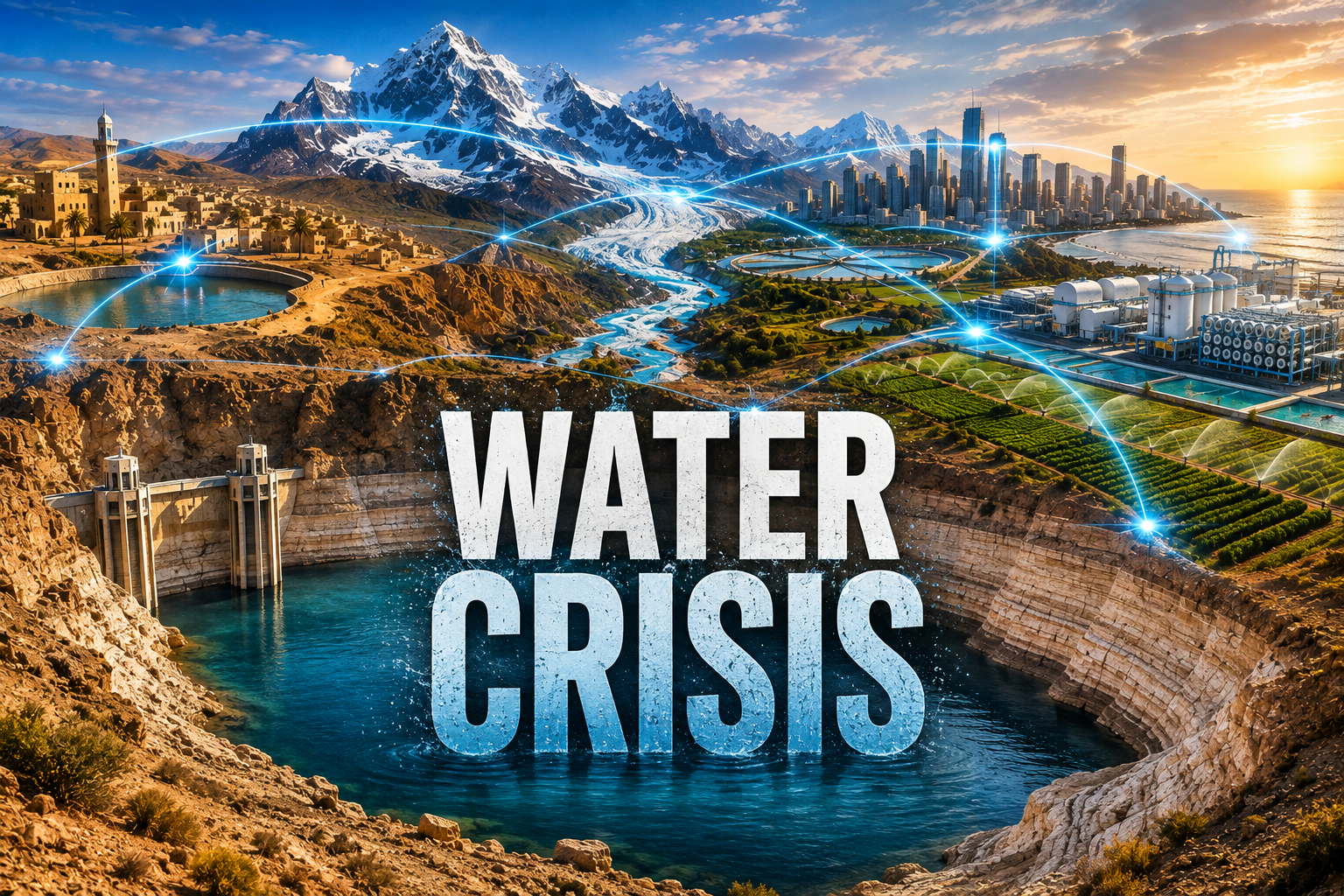
There is an uncomfortable paradox at the heart of the world's water crisis.
Earth has plenty of water.
But very little of it is readily available for human use, and even that supply is distributed unevenly across the planet. The U.S. Geological Survey notes that less than 1% of Earth's water is directly available as liquid freshwater for human use.
Meanwhile, around 2.1 billion people still lack safely managed drinking water at home, even though nearly a billion people gained access between 2015 and 2024.
The pressure isn't evenly distributed.
The Middle East and North Africa are approaching a major scarcity threshold.
South Asia depends on river systems connected to the Hindu Kush Himalayas while groundwater reserves are under pressure.
Sub-Saharan Africa faces enormous gaps in basic water infrastructure.
And even the wealthy American Southwest is confronting severe pressure on the Colorado River system.
The world's water crisis isn't one crisis with one countdown.
It is a collection of regional water problems, each running on its own clock.
The Shortage Isn't About Earth's Total Water
Imagine having an enormous warehouse full of food but most of it is locked away, stored in places you cannot reach, while the remaining supplies are concentrated in a handful of cities.
That is closer to how freshwater works.
More than 96% of Earth's water is saline, while most freshwater is locked in glaciers, ice caps or underground. Rivers and lakes, the sources humans visibly depend on, represent only a tiny fraction of the planet's total water.
So the question isn't simply:
“How much water does Earth have?”
It's:
“Where is the usable water, and can people access it when they need it?”
That distinction explains why a global water crisis can exist on a planet covered in oceans.
The Numbers Are Improving and Still Troubling
The latest WHO/UNICEF Joint Monitoring Programme data show genuine progress.
Between 2015 and 2024, about 961 million people gained access to safely managed drinking-water services.
Global coverage increased from 68% to 74%.
But that still leaves 2.1 billion people without safely managed drinking water at home. About 106 million people continue to rely directly on surface water such as rivers and lakes.
Water stress is an even broader problem.
The World Resources Institute estimates that at least 4 billion people experience highly water-stressed conditions for at least one month each year, while 25 countries, representing about one-quarter of the world's population, face extremely high water stress annually.
So there are really two different problems:
Water access:
Can people get safe water?
Water stress:
Is there enough renewable water to meet competing demand?
They overlap but they aren't the same thing.
1. Middle East & North Africa: The Region Running Out First
No region faces a more obvious structural water challenge than the Middle East and North Africa (MENA).
The World Bank projects that by 2030, water availability per person across the region will fall below 500 cubic metres per year the internationally recognised threshold for absolute water scarcity.
And the problem isn't simply a lack of rainfall.
Groundwater is increasingly becoming part of the story.
NASA's GRACE satellites have been used to track changes in total water storage across the Tigris-Euphrates basin and western Iran. A major study found that the region lost about 144 cubic kilometres of stored freshwater between 2003 and 2009, with groundwater depletion accounting for much of the decline.
That's significant because groundwater doesn't always behave like a renewable bank account.
Some aquifers refill slowly.
Others may take centuries or longer to recover.
Pumping water faster than nature replaces it turns a water supply into a mining operation.
Did You Know?
NASA's GRACE satellites can effectively “weigh” changes in Earth's water.
The satellites detect tiny changes in Earth's gravitational field caused by shifts in water mass.
When large amounts of groundwater disappear from an aquifer, the change can be detected from space.
It's one of the most remarkable examples of space technology being used to monitor something happening beneath our feet.
2. South Asia: When the Water Supply Starts in the Mountains
For South Asia, the water story begins far from many of the cities and farms that depend on it.
The Hindu Kush Himalayan region is the source of major Asian river systems including the Indus, Ganges and Brahmaputra.
The National Academies notes that these river systems provide water for more than a billion people across the region.
And the glaciers feeding these systems are changing.
The National Academies concluded that most glaciers in the Hindu Kush Himalayas were retreating, while also stressing that the exact consequences for downstream water supplies are complex and uncertain.
That uncertainty matters.
Glacier retreat doesn't simply mean:
“Less ice = less water immediately.”
In some places, increased melting can temporarily increase downstream flows.
But over longer periods, continued glacier loss can reduce the amount of stored water available during dry seasons.
At the same time, groundwater is under pressure.
The result is a difficult combination:
A changing natural water source + heavily used groundwater reserves.
That makes long-term water management particularly important.
3. Sub-Saharan Africa: The Problem Isn't Always Physical Scarcity
Water scarcity doesn't always mean there is literally no water nearby.
Sometimes the bigger problem is infrastructure.
Millions of people may live relatively close to a water source but lack reliable systems to collect, treat, transport and distribute it safely.
The original draft highlights the enormous drinking-water access gap across sub-Saharan Africa, particularly in rural areas.
This distinction is crucial.
A country can have rainfall, rivers and groundwater and still have a water crisis.
Why?
Because water has to move from nature to people.
That requires:
- Treatment plants
- Pipes
- Pumps
- Electricity
- Storage
- Maintenance
- Governance
- Investment
Without those systems, having water somewhere on the map doesn't necessarily mean having safe water in someone's home.
4. The American Southwest: Even Rich Countries Aren't Immune
It is easy to imagine water scarcity as a problem belonging to deserts or developing countries.
The Colorado River challenges that assumption.
The river supports agriculture, cities, electricity generation and ecosystems across the southwestern United States and Mexico.
In 2026, the system remains under severe pressure.
U.S. Bureau of Reclamation data show Lake Mead's elevation falling through the summer, while Lake Powell's June 2026 storage stood at about 24% of live capacity.
The problem is not simply that the reservoirs are low.
The Colorado River system was designed and managed around historical patterns of water availability that are becoming harder to rely on.
That creates a difficult question:
What happens when infrastructure built for yesterday's climate has to operate in tomorrow's?
5. Cape Town: The City That Almost Ran Out
Cape Town became a global symbol of urban water risk during the 2018 Day Zero crisis.
The city came dangerously close to shutting down normal household water supplies after years of drought.
The lesson from Cape Town is particularly interesting because the crisis demonstrated how quickly a major city can move from:
“We have enough water.”
to
“We need to change how everyone uses water.”
The city has since continued investing in water resilience and alternative sources.
In April 2026, the City of Cape Town reported that dam levels were below 50% and highlighted treated-effluent reuse as one way to reduce pressure on drinking-water supplies.
The bigger lesson is that water security isn't only about rainfall.
It is also about how efficiently a city uses every drop it receives.
Can Technology Actually Solve Water Scarcity?
Some countries are demonstrating that severe water scarcity does not automatically mean permanent water insecurity.
🇮🇱 Israel
Israel has invested heavily in desalination, wastewater reuse, efficient irrigation and water management.
The World Bank has highlighted Israel's reuse of roughly 90% of treated wastewater, much of it directed toward agriculture, as part of its broader water-management model.
The important point isn't that Israel somehow created more water.
It created a system that uses the same water more efficiently and repeatedly.
🇸🇬 Singapore
Singapore faced an entirely different problem.
It had limited land and natural freshwater resources and historically depended partly on imported water.
Its response was to diversify.
Singapore's Four National Taps combine:
- Local catchment water
- Imported water
- NEWater
- Desalinated water
NEWater is highly treated reclaimed water, and Singapore's PUB describes it as a key part of the country's long-term water strategy.
This creates an important shift in thinking.
Instead of asking:
“Where can we find another source of water?”
Singapore also asks:
“How many times can we safely reuse the water we already have?”
Knowlegic Perspective
It's easy to talk about “the global water crisis” as if the entire planet is approaching one giant deadline.
It isn't.
Different places are experiencing different versions of the same underlying problem.
In the Middle East, the challenge is how to manage demand when natural supply is extremely limited.
In South Asia, the challenge is protecting interconnected systems of rivers, glaciers, groundwater and agriculture.
In Sub-Saharan Africa, the central problem in many communities is making safe water physically accessible.
In the American Southwest, the issue is adapting a sophisticated water system to a river basin under long-term stress.
And Singapore and Israel show that technology can help—but only when combined with institutions, investment and difficult policy choices.
The deeper lesson is about inequality.
So the future of water may depend on something more complicated than rainfall.
It may depend on who gets access, who pays, who gets priority and how efficiently societies manage what they already have.
Water is easy to take for granted.
Turn a tap.
Water appears.
Flush a toilet.
Water disappears.
Grow food.
Water is already part of the process.
Generate electricity.
Water may be involved again.
That invisibility makes water different from many other resources.
You notice oil when its price rises.
You notice electricity when the power goes out.
The world's water crisis isn't really a story about a planet running out of water.
It's a story about geography, infrastructure, climate, technology and inequality.
One region may be running out of groundwater.
Another may be losing glacier storage.
Another may have plenty of rainfall but not enough pipes.
Another may have sophisticated infrastructure but a river system under unprecedented pressure.
And some countries are showing that scarcity doesn't have to become destiny.
The most important question may therefore not be:
“Will the world have enough water?”
It may be:
“Will we manage the water we have well enough and fairly enough to keep it available?”
Because water security isn't simply about having water.
It's about making sure it is there when people need it.
Enjoyed this?
Get notified when a new Knowlegic story worth knowing is published.


