

ASML: The One Company Controlling Advanced AI Chip Production
ASML is the only company on the planet that makes the machines capable of printing the most advanced computer chips, and in 2026 the United States and China are fighting over exactly how much of that technology China gets to keep.
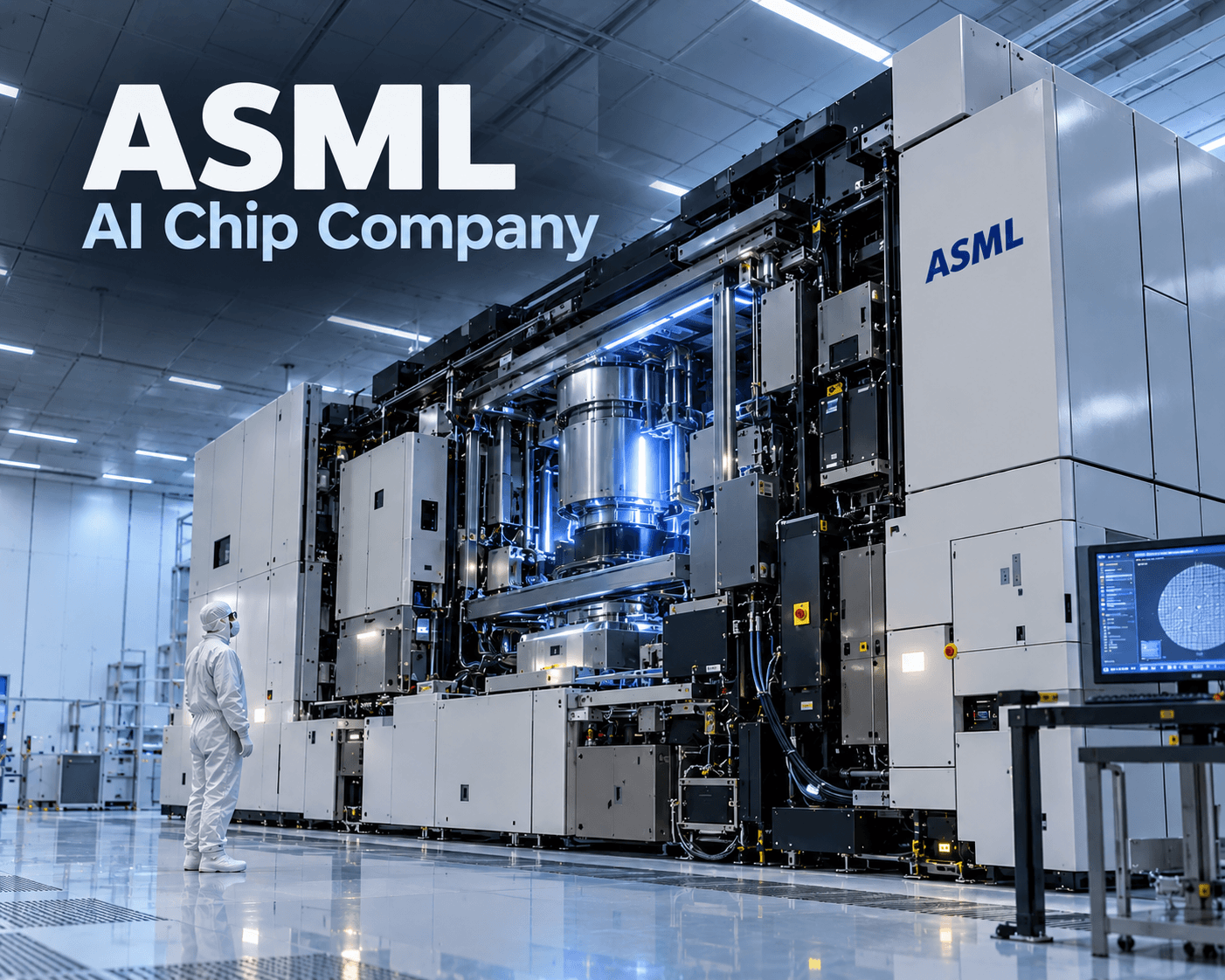
Inside a machine the size of a bus, a laser strikes droplets of molten tin fifty thousand times a second, vaporizing each one into a plasma that emits light with a wavelength of just 13.5 nanometers, short enough to etch patterns onto silicon finer than anything visible to the human eye. A standard version costs roughly 180 million dollars, the newest version more than double that, and either one weighs over 300,000 pounds and takes multiple Boeing 747s to ship in pieces.
Only one company on Earth knows how to build it. By its own count, exactly 314 of these machines exist anywhere in the world, plus 26 retired ones. In mid-2026, the U.S. government told that company's own executives it suspected one of the 314 had ended up somewhere it was never supposed to go: China.
Whoever controls that machine controls, in a very real sense, who gets to make the world's most advanced chips at all.
The Machine Nobody Else Can Build
ASML, a Dutch company most people outside the semiconductor industry have never heard of, makes extreme ultraviolet, or EUV, lithography machines: the only tools on Earth capable of printing the most advanced generation of computer chips onto silicon wafers. No competitor makes an equivalent machine. Not a cheaper, slower version. None at all.
The complexity is what keeps it that way. A single EUV machine draws on more than 5,100 suppliers worldwide for its roughly 100,000 individual parts, coordinating optics, lasers, plasma physics, and software refined over more than two decades of research that no rival has been able to replicate from scratch.
Did You Know?
ASML has published the exact count and location of every EUV machine it has ever built: 314 currently operating, 26 decommissioned, none in China. It's an unusually precise public accounting for a company, offered specifically to settle a dispute over where its most restricted product actually is.
How One Company Ended Up With the Only Copy
ASML didn't set out to become irreplaceable. It got there through one deliberate decision after another over three decades, each one narrowing the field of companies that could plausibly compete.
The turning point came in 2012, when ASML paid roughly 2.5 billion dollars to acquire Cymer, the company that built the specialized lasers EUV machines depend on to vaporize tin into plasma. Bringing that expertise in-house, rather than depending on an outside supplier for the single hardest part of the system, is widely credited with being what actually made EUV commercially viable rather than a permanent physics-lab curiosity. Around the same time, a billion-dollar investment in its longtime optics partner, Zeiss, produced mirrors built from a hundred layers each just a few nanometers thick, the components needed to direct EUV light with enough precision to matter.
By the time rivals understood how far ahead ASML's approach had pulled, the physics, the supply chain, and the accumulated engineering knowledge had become too expensive and too slow to replicate from scratch. Three decades of research and billions of dollars in accumulated investment is not a gap a competitor closes with a strong quarter.
The Machine That May or May Not Be in China
EUV machines have never been legally shipped to China. The restriction dates back to the first Trump administration, and ASML has maintained it has honored that line completely.
In April 2026, U.S. Commerce Secretary Howard Lutnick began a series of private meetings with ASML's senior leadership, raising concerns that a restricted EUV system, or at least components and transport equipment specific to one, might have reached China anyway. Administration officials told Bloomberg they had evidence supporting the concern, though they declined to show it to ASML directly.
ASML's response was categorical. The company has never shipped an EUV machine, or any component built specifically for one, to China, and its public accounting of all 314 active units and 26 retired ones supports that claim. Neither side has produced evidence the other finds conclusive, which is itself the point: even the two parties closest to the technology can't fully verify where every restricted machine actually is.
Closing the Last Loophole
While EUV machines were already banned outright, an older and more common generation, deep ultraviolet, or DUV, lithography tools, had remained legal to sell to China under looser rules. Chinese chipmakers, most notably SMIC, have used specific DUV models from ASML and Japan's Nikon to manufacture chips as advanced as the 7-nanometer node, a level well beyond what U.S. policy intended China to reach through legal channels.
A bipartisan bill introduced in the House in April 2026, called the MATCH Act, aims to close that gap. It would ban the export of the specific DUV tools SMIC has relied on, and go further by banning servicing of machines already installed in China, cutting off the maintenance and parts that keep existing equipment running. The bill gives the Netherlands and Japan, home to ASML and Nikon respectively, 150 days to align their own export rules with the new U.S. standard or face the possibility of unilateral American sanctions.
The bill names specific targets: SMIC, Huawei, CXMT, YMTC, and related companies would be treated the way the U.S. treats firms on its formal Entity List, cut off not just from new equipment but from technical support for equipment they already own.
What's Actually at Stake for China
China accounted for roughly a third of ASML's total sales in 2025. Tightening controls are expected to push that share down to around a fifth in 2026, and the MATCH Act, if it passes largely intact, would cut deeper still.
China's own attempt to build a domestic alternative isn't close to catching up. Independent industry analysis has estimated China's working EUV light source at somewhere in the range of 100 to 150 watts of power, well short of the 600 watts ASML's current machines operate at, and even short of the 250-watt benchmark ASML had already cleared back in 2017. Neither government publishes detailed specifications, so those specific wattage figures carry real uncertainty, but the general picture is not in dispute: independent assessments put a commercially viable Chinese EUV machine somewhere around 2030, not because the physics is a secret, but because matching decades of accumulated engineering takes decades, not a crash program.
That gap is exactly why the fight over servicing existing machines matters as much as the fight over selling new ones: a chipmaker that already owns older equipment can keep running it, and keep climbing the technology ladder, as long as someone is still willing to maintain it. That's the specific leverage the MATCH Act is built to remove.
None of this changes who currently holds the chips at the center of the AI industry. It changes how much harder it becomes for anyone else to catch up.
Knowlegic Perspective
Most of the AI chip story gets told through Nvidia and the companies buying its processors by the hundreds of thousands. That's the visible layer. One level beneath it sits a company that makes none of the chips itself and appears in almost none of the headlines about the AI boom, yet holds a more absolute chokehold on the industry than anyone above it: the only company on Earth that can build the machines those chips require.
That kind of leverage is unusual even by the standards of a highly consolidated tech industry. Nvidia has real, if distant, competitors. Cloud providers have several serious rivals apiece. ASML has none, in a business where the alternative to using its machines isn't a worse option: it's no option at all.
Whoever controls that machine controls, in a very real sense, who gets to make the world's most advanced chips at all, and in 2026, that control is being argued over in private meetings and congressional bills as much as it's being exercised on any factory floor.
Sources & References
- The US says ASML's top chip tool may be in China, but how?, TechCrunch (2026)
- Congress moves to strip the DoC of chip-export discretion with the MATCH Act, Tom's Hardware (2026)
- Exclusive look at the creation of High NA, ASML's new $400 million chipmaking colossus, CNBC (2025)
- ASML High-NA EUV Twinscan EXE Machines Cost $380 Million, Tom's Hardware (2026)
- China's EUV Lithography Progress: Parsing Signal From Noise, The Diplomat (2026)
- ASML: A Monopoly on Magic, The Generalist (2025)
Enjoyed this?
Get notified when a new Knowlegic story worth knowing is published.


