

Comics Byte: The Website Keeping India's Comic-Book Memory Alive
Why India's comic-book past nearly slipped away, and what one obsessive website reveals about how a culture decides to remember, or forget, the things it grew up with.
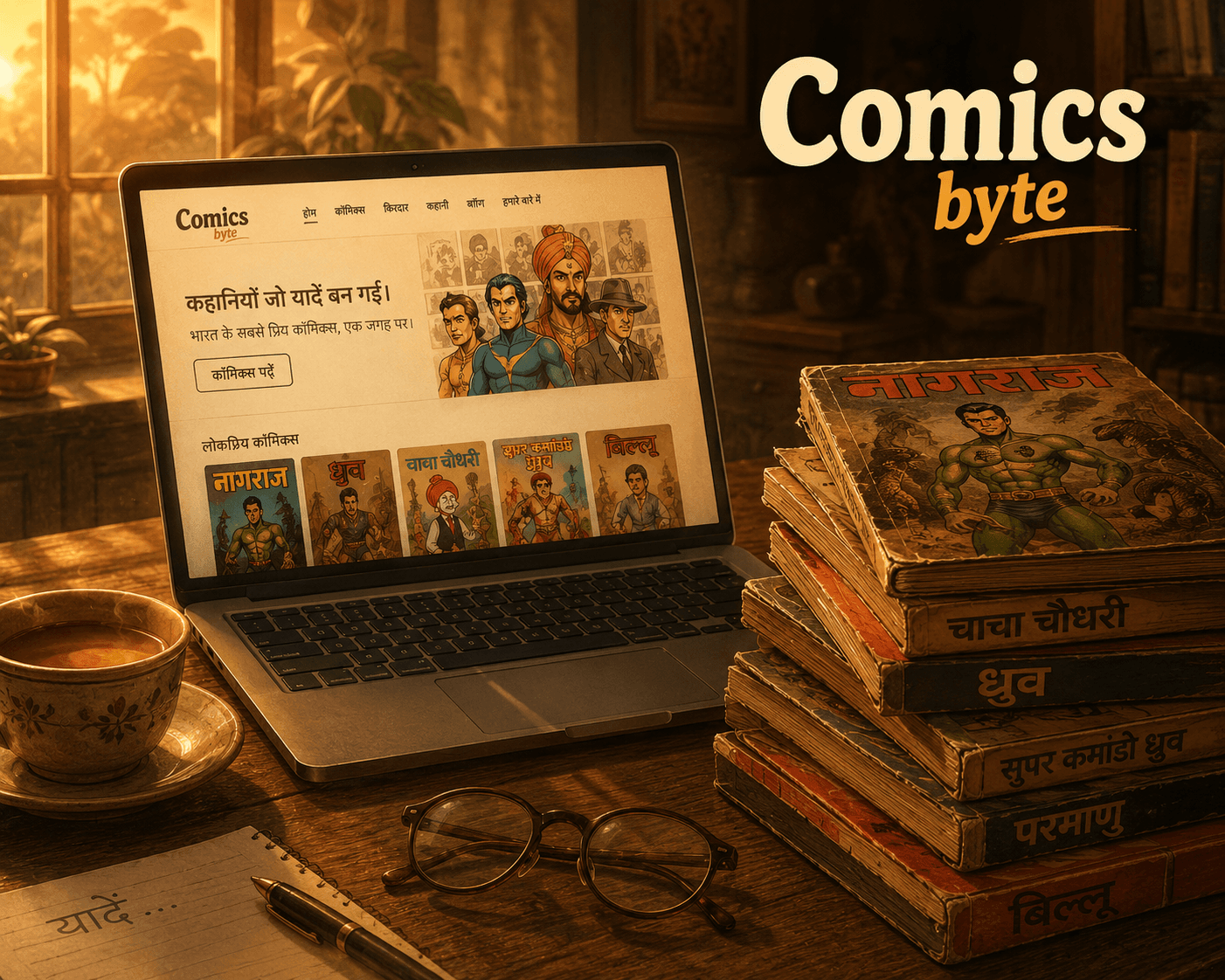
Somewhere right now, an adult is typing a half-remembered description into a search bar. "Green superhero snake India." "Old comic fat man red turban giant friend." "Phantom Hindi comic 1970s."
They are trying to find a piece of their childhood, and for a long time the search would end in a dead link, a blurry forum post, or nothing at all.
More and more, it ends at Comics Byte, a site that has quietly become the place where India's comic-book past is written down, checked, and kept. Its subject is niche. What it keeps finding is not.
A Beat Nobody Else Was Fully Covering
Indian cinema has critics, archives and film schools. Cricket has statisticians who can reconstruct a 1987 over from memory. Indian comics, for decades, had warm nostalgia and very little record.
That is the gap Comics Byte works in. It covers new releases from publishers like Raj Comics and Amar Chitra Katha, reviews individual titles the way a film critic reviews a movie, writes character histories, and collects the vintage advertisements that ran inside old issues. It follows the international side too, from Marvel pricing to the Phantom, because those stories shaped what Indian readers grew up with.
The tone is enthusiastic but not uncritical, which is rare in fan media. A 30-year-old comic gets judged on whether it still holds up, not just whether it makes the writer feel young again.
The Facts It Keeps Turning Up
Spend an afternoon in the archive and the same thing keeps happening: a detail stops you cold.
Nagraj, the green-skinned hero often called India's number one superhero, was first sketched as a weapon, a villain meant to be defeated, before Raj Comics rewrote him into the protagonist. Super Commando Dhruva, created in 1987, has no powers at all and solves everything through observation and training, which made him a deliberate contrast to the super-powered crowd around him.
Amar Chitra Katha's founder, Anant Pai, started the whole mythology-comics tradition in 1967 because he saw Indian students answering quiz questions about Greek gods and missing questions about their own epics. He numbered the first issue, Krishna, as number 11 rather than 1, for luck.
Chacha Chaudhary, the Diamond Comics everyman, was created by the cartoonist Pran in 1971 for a Hindi magazine before becoming a publishing empire. His giant sidekick Sabu is an alien from Jupiter. And the very first widely sold comic in India, Indrajal Comics in 1964, ran Lee Falk's the Phantom in Hindi, sometimes editing the American artwork down to fit a 16-page slot.
Did You Know?
The name of Comics Byte's humour section, Moorkhistan, is itself an inside joke. "Moorkh" means fool, and an imaginary country full of them is a fitting home for a genre that includes Bankelal, a Raj Comics character who spends every single issue scheming to kill a king and failing. The section name signals that the site is run by people fluent in the material, not tourists passing through.
Why the Old Advertisements Matter
One of the site's more original habits is taking the advertisements inside old comics seriously.
On their own, a 1990 mail-order ring offer or a decoder-toy coupon is kitsch.
Read together, across years, they are social history:
What was an Indian child being sold?
For how many rupees?
And what was that child assumed to want?
Western comics scholarship has mined its own old ads for decades. Doing it for Hindi comics is close to new.
There is a practical payoff too. Reprints usually strip out or replace original advertising, so an issue that still carries a period ad with a printed deadline is far more likely to be a genuine first print run.
A tiny advertisement can tell a surprisingly large story.
A Record Before the Paper Crumbles
The quiet urgency behind the site is physical. A lot of this material was printed on cheap newsprint that browns and flakes. Publisher archives are uneven. Fan memory is affectionate but unreliable, and it disagrees with itself.
So the work doubles as preservation. A review keeps an old comic in the conversation. A cataloguing of an artist's run keeps a creator's name attached to the pages they drew. A scan of a 1988 advertisement saves a small, ordinary piece of the past from vanishing entirely.
The Indian comics industry had a brutal decade, roughly 2000 to 2010, when cable television and the internet pulled readers away and more than 50 publications shut down. The revival since then is built on reprints and on adults rebuying the stories they grew up with, and it only works if someone remembers what came before. Increasingly, that someone is a website.
Interesting Facts: "Raj Comics" is now more than one company. In late 2020 the founding family's business split among the sons of its founder, producing Raj Comics by Sanjay Gupta and Raj Comics by Manoj Gupta, which share the old logo but run separate storylines and pricing. Keeping readers straight on which Nagraj belongs to which camp is exactly the kind of untangling Comics Byte exists to do.
Knowlegic Perspective
It would be easy to file a site like this under nostalgia and move on. That undersells it.
Nostalgia looks backward and feels something.
An archive looks backward and writes it down, so the next curious person does not have to start from nothing.
There are plenty of places on the internet where you can find an old comic image, a character name or a scattered piece of information.
What is much harder to find is one dedicated space bringing the pieces together, the publishers, characters, creators, stories, advertisements, releases, history and the little details that make these comics distinctly Indian.
That is what makes Comics Byte unique.
For Knowlegic, this makes Comics Byte more than another content category.
And it isn't interested only in the famous names.
It is interested in what makes Nagraj feel like Nagraj.
Why Chacha Chaudhary became more than a cartoon character.
Why Dhruva's lack of superpowers was part of his appeal.
Why Bankelal's endless failures became part of the fun.
Why Bahadur looked and behaved differently from the imported heroes who came before him.
Why the Phantom speaking Hindi on an Indian newsstand matters.
These characters weren't simply translated into India.
Over time, many of them became part of India's own cultural memory.
That is the essence Comics Byte is trying to capture.
Not just what the comics were. But why they mattered.
It is a dedicated record of Indian comic culture, a place where the characters, creators, publishers, stories and memories can exist together.
Because when old newsprint disappears, the stories shouldn't have to disappear with it.
Comics Byte exists to make sure they don't.
Sources & References
- https://comicsbyte.com/
- 'Krishna': Remembering Anant Pai's iconic Amar Chitra Katha comic book published 50 years ago, Scroll.in (2020)
- Chacha Chaudhary, Wikipedia (2024)
- Raj Comics, Wikipedia (2024)
- Raj Comics: publishers who brought home your friendly, neighbourhood desi superheroes, ThePrint (2022)
- A Complete Timeline: The Evolution of Comic Books in India (1926 - Present), Homegrown (2023)
Enjoyed this?
Get notified when a new Knowlegic story worth knowing is published.


