

What Area 51 Actually Is - And Why the Secrecy Made It a Myth
The CIA didn't officially print the words "Area 51" in a government document until 2013. By then, the secret site had been operating for almost 60 years and the mystery had already become bigger than the facts.
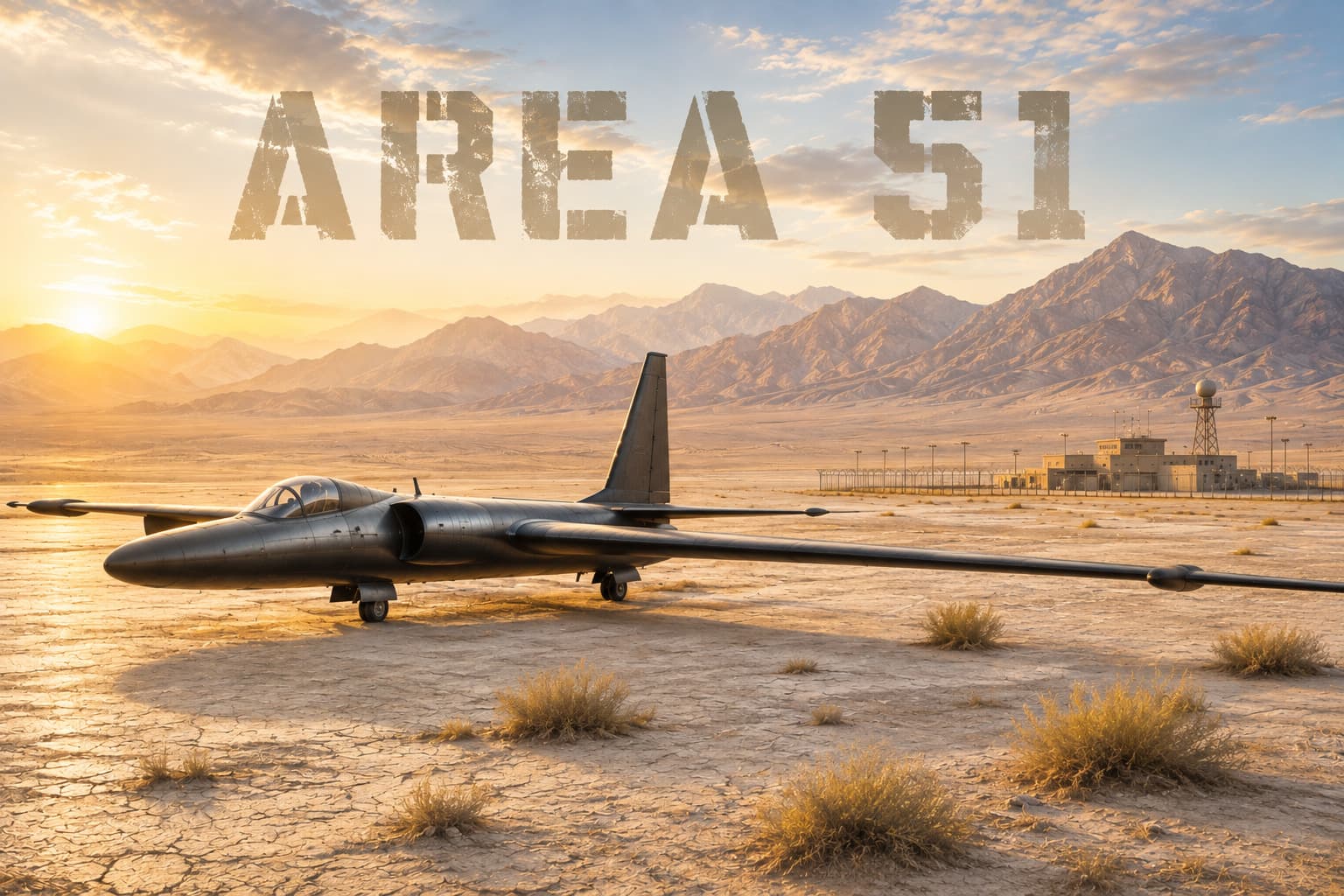
For decades, Area 51 became synonymous with UFOs, aliens and government conspiracies.
But the documented history is far more fascinating.
The remote Nevada site was selected in 1955 as a secret testing ground for the U-2 spy plane, an aircraft designed to fly at altitudes beyond the reach of the air defenses of its era.
Aircraft were flying unusually high and fast over the Nevada desert. People saw them.
The government couldn't explain them.
And because the real explanation was classified, speculation filled the gap.
The CIA didn't officially print the words "Area 51" in a government document until August 2013, almost six decades after the site began operating.
The government wasn't hiding aliens.
It was hiding an airplane.
And it turns out that hiding an airplane well enough for sixty years was more than enough to create a legend.
The Plane That Started It All
In 1955, the Cold War was intensifying.
The United States needed a way to understand what was happening inside the Soviet Union without sending conventional aircraft into situations where they could easily be detected or intercepted.
The answer was the U-2.
The CIA selected Groom Lake, a remote dry lakebed in Nevada surrounded by mountains, as the testing location.
It offered exactly what the program needed:
Isolation.
The U-2 took its first flight there on August 4, 1955.
It was designed to fly at around 70,000 feet, far above the altitude of ordinary civilian aircraft of the time. From that height, it could photograph areas of the Soviet Union that were otherwise extremely difficult to observe.
And this created an unexpected problem.
People started seeing things in the sky that they couldn't explain.
When Secret Aircraft Started Looking Like UFOs
Imagine looking up at the sky in the 1950s and seeing a strange object moving at an altitude no ordinary aircraft could reach.
You wouldn't know about the U-2.
Almost nobody outside the program did.
To make matters even more confusing, the CIA reportedly arranged for air traffic controllers to record reports of unusual high-altitude objects rather than openly discussing them over radio communications.
The public saw something strange.
Officials couldn't explain it.
And the actual explanation was classified.
That is a perfect recipe for a mystery.
The U-2 wasn't an alien spacecraft.
But to someone watching from the ground, a secret aircraft that officially didn't exist could look an awful lot like one.
Did You Know?
The name "Area 51" itself has an unusual origin.
It came from Atomic Energy Commission grid maps associated with nearby nuclear testing areas in the 1950s. According to CIA accounts, the site was assigned a number that didn't actually fit the normal grid system helping make it harder to trace.
Over the years, the location also acquired names such as Paradise Ranch, the Ranch, Watertown and Dreamland.
Area 51 Wasn't Just About the U-2
The U-2 was only the beginning.
As Soviet air defenses improved, the United States needed aircraft that could operate even faster and higher.
The answer was another generation of secret aircraft.
The A-12 OXCART first flew at Groom Lake in April 1962.
Its purpose was similar: gather intelligence while making interception extraordinarily difficult.
The aircraft was fast enough to outrun the missiles that threatened it.
Its Air Force cousin, the SR-71 Blackbird, would eventually become one of the fastest aircraft ever built.
So while popular culture associated Area 51 with extraterrestrials, the site's documented history already contained something extraordinary:
Aircraft that seemed almost impossible by the standards of their time.
The Year Area 51's Secrets Nearly Started a Diplomatic Crisis
The secrecy surrounding these aircraft wasn't merely theatrical.
It had serious geopolitical consequences.
On May 1, 1960, U-2 pilot Francis Gary Powers was shot down while flying deep inside Soviet airspace near Sverdlovsk.
Washington initially attempted to explain the incident as a weather-research flight.
That explanation quickly collapsed.
The Soviet Union had Powers alive.
It had the aircraft wreckage.
And it had evidence that the United States had been conducting espionage missions over Soviet territory.
The incident happened just weeks before a major Paris summit intended to ease Cold War tensions.
Instead, the U-2 incident helped derail those efforts.
Powers was convicted of espionage and spent nearly two years in a Soviet prison before being exchanged for a captured Soviet spy in 1962.
Suddenly, the secret aircraft program wasn't just a strange story in the Nevada desert.
It had become part of the most dangerous geopolitical confrontation on Earth.
The Secret That Took 60 Years to Print
Here's perhaps the strangest part of the Area 51 story.
The location wasn't simply secret.
Its name was effectively secret too.
The CIA's internal history of the U-2 and OXCART programs was written by agency historians in 1992.
But the document itself remained classified.
A 2005 Freedom of Information request eventually helped release a version in which the words "Area 51" were restored.
Then, in August 2013, the CIA released the declassified history publicly.
It was the first time the US government had officially put the name Area 51 on paper.
Think about that.
The site had existed since 1955.
Aircraft had been tested there.
The U-2 had flown there.
The A-12 had flown there.
And yet the government didn't officially acknowledge the famous name until 2013.
By then, the myth had had nearly sixty years to grow.
The Secrecy Didn't End in 2013
Declassification didn't suddenly turn Area 51 into an ordinary tourist attraction.
Its airspace remains restricted, and current programs at the site remain undisclosed.
The location is officially associated with the Nevada Test and Training Range, part of Nellis Air Force Base.
What is publicly known today is largely what has already aged out of classification.
And that creates an important distinction:
Something can be officially acknowledged without becoming completely transparent.
We know much more about Area 51 than previous generations did.
But we still don't know everything happening there.
So Why Did Area 51 Become an Alien Legend?
This is where the story becomes bigger than Area 51 itself.
Consider what the public experienced:
Strange aircraft
↓
Unusual flight patterns
↓
Government secrecy
↓
No official explanation
↓
Decades of silence
↓
Speculation
The missing information became the story.
If people see something they don't understand and the authorities refuse to explain it, there is a vacuum.
And humans don't like vacuums.
We fill them.
Sometimes with reasonable assumptions.
Sometimes with extraordinary ones.
Area 51 became one of the world's most famous examples of what happens when secrecy meets imagination.
The Real Mystery Was the Silence
Area 51 doesn't need aliens to be fascinating.
Think about what actually happened there.
A remote desert testing facility.
Aircraft designed to fly beyond the reach of an entire generation of air defenses.
A program secret enough to influence what air traffic controllers recorded.
A U-2 incident that nearly disrupted a superpower summit.
And a location whose famous name remained officially unacknowledged for almost sixty years.
That's already an extraordinary story.
The aliens were never necessary.
The secrecy was enough.
Knowlegic Perspective
Secrecy has an interesting side effect.
From the outside, a completely ordinary secret and an extraordinary secret can look exactly the same.
Imagine a room behind a closed curtain.
You can see that the room is occupied.
But you can't see what's inside.
It could contain nothing remarkable.
Or it could contain something extraordinary.
From outside, both possibilities look identical.
That gap between what is known and what is imagined is where speculation thrives.
And the longer the curtain stays closed, the bigger the story behind it can become.
Area 51 demonstrates this perfectly.
The actual story secret aircraft, Cold War intelligence and extraordinary aviation technology—was fascinating enough.
But because the public didn't have the facts, imagination created a different story.
And that story became more famous than the truth.
Why It Matters
Area 51 is ultimately a story about more than secret aircraft.
It is a story about information.
When information is available, people can evaluate facts.
When information is restricted, people construct explanations.
And when that restriction lasts for decades, those explanations can become cultural myths.
That's why Area 51 remains fascinating even after its existence is no longer officially denied.
The mystery wasn't created by what the government revealed.
It was created by everything it couldn't or wouldn't say.
The government wasn't hiding aliens.
It was hiding an airplane.
An airplane designed to fly higher than almost anything the world had seen.
A plane tested at a remote desert site whose very name stayed out of official government documents for nearly sixty years.
And perhaps that's the most fascinating lesson of Area 51:
Keep an ordinary secret well enough, for long enough, and something extraordinary will eventually grow in the space where the facts should have been.
Enjoyed this?
Get notified when a new Knowlegic story worth knowing is published.


