

What Would Actually Happen If Earth Stopped Spinning?
A Minute-by-Minute Journey Through One of Science's Most Fascinating Thought Experiments
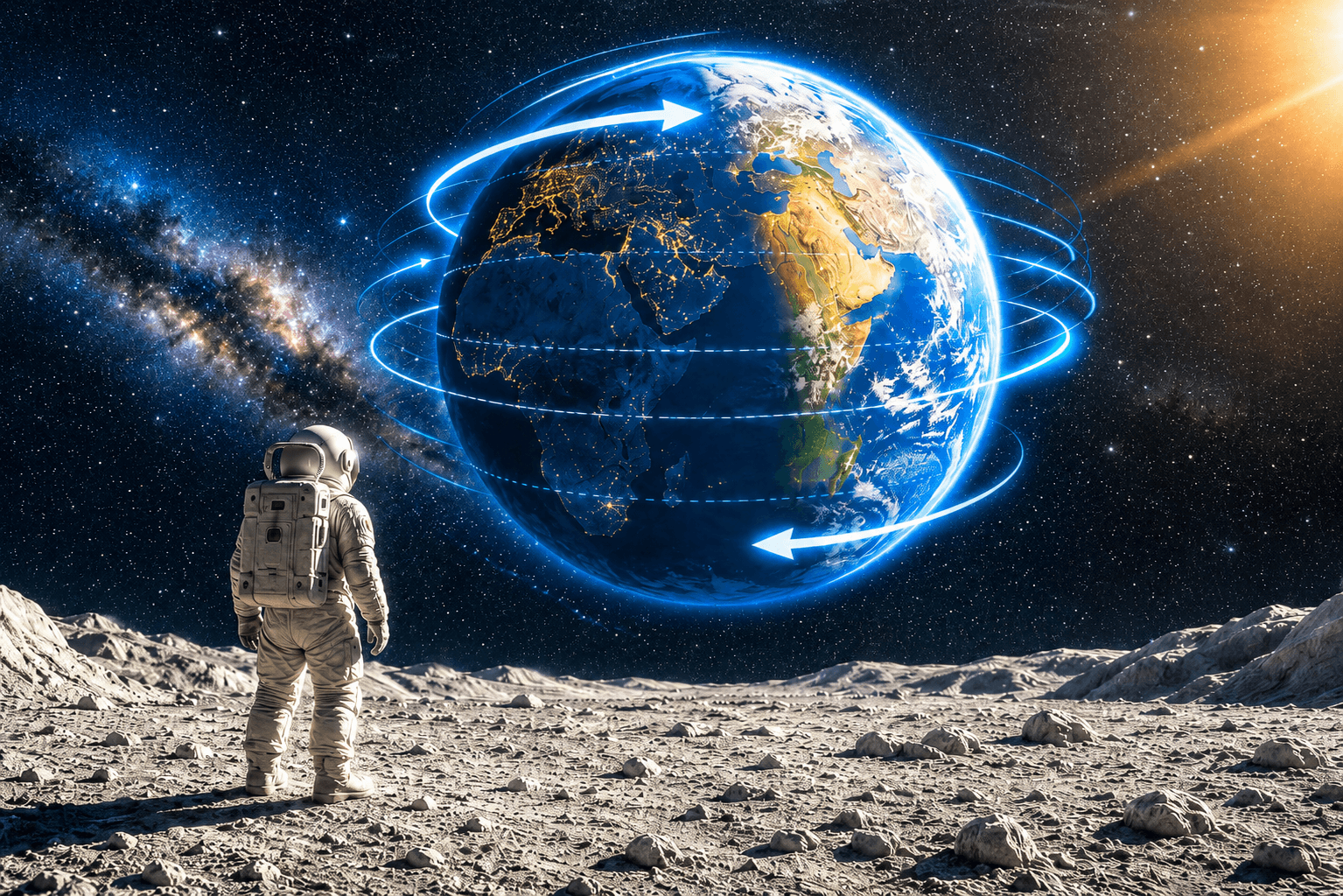
Every second of every day, Earth spins at nearly 1,670 km/h (1,037 mph) at the equator. We never feel it because everything around us- including the atmosphere, oceans, and ourselves—is moving at the same speed.
But what if Earth suddenly stopped spinning?
Could gravity disappear? Would we be thrown into space? Would the Sun remain frozen in the sky? Could life survive?
Although such an event is physically impossible under our current understanding of physics, scientists can use the laws of motion, gravity, and climate science to predict what would likely happen. The result is both terrifying and deeply fascinating and it reveals just how much of our everyday life depends on an invisible motion we rarely think about.
Have You Ever Thought About How Fast You're Moving Right Now?
Take a moment and look around.
Your chair isn't shaking.
The floor feels perfectly still.
Nothing suggests you're moving.
And yet, if you're standing near Earth's equator, you're travelling at around 1,670 kilometers per hour, faster than the cruising speed of many commercial aircraft.
You're not driving.
You're not flying.
You're simply standing on a planet that's quietly spinning beneath your feet.
It's one of nature's greatest illusions.
Earth has been rotating for about 4.5 billion years, completing one full turn every 24 hours. That single motion gives us sunrise and sunset, influences our weather, shapes the oceans, and helps regulate the climate that makes life possible.
We rarely notice it because everything around us- the air, the oceans, the buildings, and even our bodies moves together with the planet.
But imagine that, somehow, all of it changed in an instant.
No warning.
No countdown.
No gradual slowdown.
Just... stop.
What would happen next?
First, Let's Clear Up One Big Misconception
Before we continue, it's important to understand something.
This scenario is a thought experiment.
According to everything scientists currently know about physics, Earth cannot simply stop spinning instantly. The amount of energy involved is so enormous that no known natural process could bring the planet to an immediate halt.
So why ask the question at all?
Because thought experiments are one of science's most powerful tools.
Albert Einstein imagined riding alongside a beam of light long before technology could test many of his ideas. Physicists routinely ask "What if?" questions to better understand how nature works.
In this article, we're doing the same thing.
We're using well-established laws of physics to explore an extraordinary hypothetical event.
0 Seconds: The Moment Earth Stops
Now imagine the impossible happens.
Earth's rotation suddenly stops.
The planet itself is no longer turning.
But here's the catch:
Everything that wasn't firmly attached to the planet is still moving.
This happens because of a principle known as inertia.
If you've ever been in a car that suddenly brakes, you've experienced inertia. Your body continues moving forward even though the car has slowed down.
The same principle applies on a much larger scale.
The ground stops.
You don't.
At the equator, that means you and the atmosphere, oceans, cars, trees, and buildings would continue moving eastward at roughly 1,670 km/h.
That's faster than the speed of sound.
The consequences would be catastrophic.
Powerful winds would sweep across the planet.
Structures never designed to withstand such forces would fail.
Loose objects would become deadly projectiles.
Near the poles, where Earth's rotational speed is much lower, the effects would be less dramatic. But across much of the world, the first moments would be unlike anything humanity has ever experienced.
Inertia Doesn't Stop Just Because Earth Does
Objects in motion naturally remain in motion unless another force acts on them.
When the ground stops suddenly, everything moving with Earth tries to keep moving.
It's not Earth's stop that causes the devastation.
It's everything else refusing to stop at the same time.
The First Minute
If the initial shock wasn't enough, the atmosphere now becomes the next challenge.
Earth's air has been rotating with the planet for billions of years.
When the ground suddenly stops, the atmosphere keeps moving.
Imagine the strongest hurricane ever recorded.
Now imagine winds many times faster, racing across continents.
Such winds would reshape landscapes, uproot forests, and scatter debris over enormous distances.
Meanwhile, the oceans would continue moving too.
Coastlines would experience unimaginable flooding as vast amounts of water surged inland.
Some regions might see towering waves, while others could eventually find themselves far from any coastline at all.
The world map we've known for centuries would begin to change.
One Hour Later
By now, the immediate violence has begun to settle.
But something else becomes impossible to ignore.
The Sun isn't moving the way it normally does.
That's because our familiar cycle of sunrise and sunset isn't caused by the Sun circling Earth.
It's caused by Earth rotating beneath the Sun.
If Earth stopped rotating while continuing to orbit the Sun, the familiar 24-hour day would disappear.
Instead, daylight and darkness would each last for months.
Imagine waking up to a sunrise that wouldn't end for nearly half a year.
Or facing a night that seemed endless.
Our biological clocks, agriculture, and ecosystems all built around a 24-hour rhythm-would be thrown into chaos.
Gravity Doesn't Disappear
One of the biggest myths is that Earth must spin to create gravity.
It doesn't.
Gravity exists because Earth has mass.
Even if Earth stopped rotating, gravity would continue pulling us toward the ground.
The planet would still hold onto its oceans and atmosphere.
Rotation changes gravity only slightly by creating a small outward effect, strongest at the equator. Remove the spin, and that effect disappears but gravity itself remains.
One Day Later
Without the regular cycle of day and night, temperatures begin drifting toward dangerous extremes.
The side facing the Sun absorbs continuous heat.
The opposite side loses heat to space with no sunrise to warm it.
On today's Earth, rotation helps spread energy around the globe. Air currents and ocean currents constantly redistribute heat, preventing enormous temperature differences between regions.
Now, many of those circulation patterns begin breaking down.
Weather as we know it starts disappearing.
Jet streams weaken.
Storm systems change.
Rainfall patterns shift dramatically.
Some regions become hotter than ever before.
Others begin freezing.
The planet is no longer behaving like the Earth we've always known.
 One Month Later: Earth Begins to Look Like Another Planet
A month has passed.
Humanity has survived the initial chaos but the planet itself is transforming.
Look at a globe.
Notice how Earth isn't a perfect sphere.
It's slightly wider around the equator than from pole to pole, bulging outward by about 43 kilometers (27 miles). This subtle shape exists because our planet has been spinning continuously for billions of years.
When that spin disappears, so does the force that helped create the bulge.
The oceans respond first.
Water naturally seeks the lowest gravitational level. Over time, enormous amounts of seawater begin flowing away from the equator toward the poles.
Imagine draining a giant swimming pool.
Some coastal regions near the equator would see the sea retreat hundreds of kilometers, exposing land that has been hidden beneath water for millions of years.
Elsewhere, water would accumulate toward the polar regions, flooding landscapes that have never been underwater in human history.
The continents wouldn't move.
The oceans would.
Maps that have guided explorers, sailors, and pilots for centuries would no longer describe the world.
Earth Isn't a Perfect Ball
Although we often picture Earth as a perfect sphere, it actually bulges slightly around the equator because of its rotation.
Scientists call this an oblate spheroid.
Without rotation, Earth would gradually become more spherical, changing the way oceans are distributed across the planet.
Six Months Later: One Endless Day, One Endless Night
Now imagine living in a city where the Sun hasn't set for six months.
At first, it might seem beautiful.
The sky remains bright.
Solar panels generate endless electricity.
But slowly, the consequences begin to appear.
The ground dries.
Lakes shrink.
Plants struggle as temperatures continue rising.
Meanwhile, on the opposite side of the planet, another world exists.
There, the Sun hasn't risen for months.
Temperatures plunge.
Snow and ice spread.
Entire ecosystems face conditions they were never evolved to survive.
Today's Earth experiences relatively gentle daily heating and cooling because it rotates every 24 hours.
Without that rhythm, the contrast between the sunlit and dark sides becomes increasingly extreme.
Life has adapted to sunrise and sunset.
It has never experienced permanent day or permanent night.
Would Seasons Still Exist?
Surprisingly...
Yes.
This is one of the biggest misconceptions about Earth's motion.
Many people assume seasons happen because Earth spins.
They don't.
Seasons are caused by Earth's 23.5° axial tilt as it orbits the Sun.
Even if Earth stopped rotating, it would almost certainly continue travelling around the Sun.
That means seasons would still occur.
But they would be experienced very differently.
Instead of familiar daily cycles within each season, regions would endure months of continuous sunlight followed by months of darkness as Earth completed one orbit around the Sun.
A single sunrise might last an entire season.
 Rotation and Revolution Are Not the Same
Rotation
- Earth spins on its axis.
- Takes about 24 hours.
- Creates day and night.
Revolution
- Earth travels around the Sun.
- Takes about 365 days.
- Creates the yearly cycle of seasons.
Two different motions.
Two very different jobs.
Could Airplanes Still Fly?
This question surprises many readers.
The answer is...
Yes—but under very different conditions.
Airplanes don't stay in the sky because Earth rotates.
They fly because wings generate lift as air moves around them.
However, the atmosphere would no longer behave as it does today.
Powerful global winds would reshape weather systems.
Jet streams would change dramatically.
Flight routes, if aviation still existed, would look nothing like today's network.
Pilots would be navigating an atmosphere unlike any humans have ever experienced.
What About Earth's Magnetic Field?
Another common misconception is that Earth's rotation directly creates its magnetic field.
Not exactly.
Earth's magnetic field is generated mainly by the movement of molten iron within the outer core—a process known as the geodynamo.
An instantaneous stop in Earth's rotation wouldn't make the magnetic field vanish overnight.
Scientists continue to study the complex relationship between Earth's rotation, its liquid core, and the long-term behaviour of the magnetic field.
While some gradual changes could occur over geological timescales, the magnetic shield protecting Earth from harmful solar radiation would not simply disappear the moment rotation stopped.
Could Anything Survive?
At this point, it might seem as though life has no chance.
Reality is a little more nuanced.
Large ecosystems would face enormous challenges.
Agriculture would be transformed.
Many familiar habitats could disappear.
Yet life on Earth has repeatedly demonstrated extraordinary resilience.
Microorganisms living deep beneath Earth's surface survive without sunlight.
Creatures near deep-sea hydrothermal vents thrive in complete darkness.
Some organisms can tolerate extreme heat, freezing temperatures, intense radiation, or crushing pressure.
Humanity, too, has one powerful advantage:
Technology.
Underground shelters.
Artificial lighting.
Controlled agriculture.
Renewable energy.
Advanced engineering.
Survival would be incredibly difficult—but not necessarily impossible.
History has shown that humans are remarkably adaptable.
The question would no longer be whether we could preserve our current way of life.
It would be whether we could invent a completely new one.
The Toughest Survivors Might Be the Smallest
Some of Earth's simplest organisms have survived conditions that would be fatal to humans.
Scientists have discovered microbes living:
- Deep beneath Earth's crust
- Inside Antarctic ice
- Near boiling hydrothermal vents
- In highly acidic lakes
These extremophiles remind us that life often finds surprising ways to endure.
The Invisible Force We Never Notice
It's easy to think of Earth's rotation as just another scientific fact.
A number in a textbook.
A diagram in a classroom.
But after exploring this thought experiment, it becomes something much more meaningful.
That quiet, steady spin shapes almost every aspect of the world we know.
It helps guide the winds that bring rain to crops.
It influences ocean currents that regulate climate.
It creates the daily rhythm that plants, animals, and humans have followed for millions of years.
Most importantly, it reminds us of something remarkable:
The stability of our planet is not something we earned.
It's something we've inherited.
Every sunrise you've ever watched.
Every evening breeze you've ever felt.
Every 24-hour day you've ever lived.
All are gifts of a planet that has never stopped turning.
Until you imagine a world without that motion, it's easy to overlook just how extraordinary ordinary Earth really is.
Key Takeaways
- Earth rotates once every 24 hours, creating the familiar cycle of day and night.
- An instantaneous stop is not physically realistic, but it serves as a valuable scientific thought experiment.
- Gravity would continue because it depends on Earth's mass, not its rotation.
- Inertia would make the first moments extremely destructive as the atmosphere, oceans, and everything on the surface continued moving.
- Earth's rotation influences weather patterns, ocean circulation, and the planet's slightly bulging shape.
- Earth would continue orbiting the Sun, so seasons would still exist, although day and night would last for months.
- Life would face immense challenges, but some organisms—and perhaps humans with advanced technology—might still survive.
Science often begins with impossible questions.
What if gravity suddenly vanished?
What if dinosaurs had never gone extinct?
What if Earth stopped spinning?
The value of these questions isn't that they predict the future.
It's that they reveal how the universe works today.
Sometimes, the fastest way to appreciate something is to imagine living without it.
Earth's rotation is one of those invisible miracles.
We don't notice it because it has never failed us.
Yet every single day, it quietly shapes the conditions that make life possible.
Perhaps the greatest lesson from this thought experiment isn't about catastrophe.
It's about gratitude for a planet whose constant motion has been keeping time for billions of years.
Enjoyed this?
Get notified when a new Knowlegic story worth knowing is published.


