

Diamond Wasn't Supposed to Make Electricity
A sheet of diamond thin enough to bend was flexed in a Hong Kong lab, and a voltmeter twitched. For 120 years the textbooks said that could not happen.
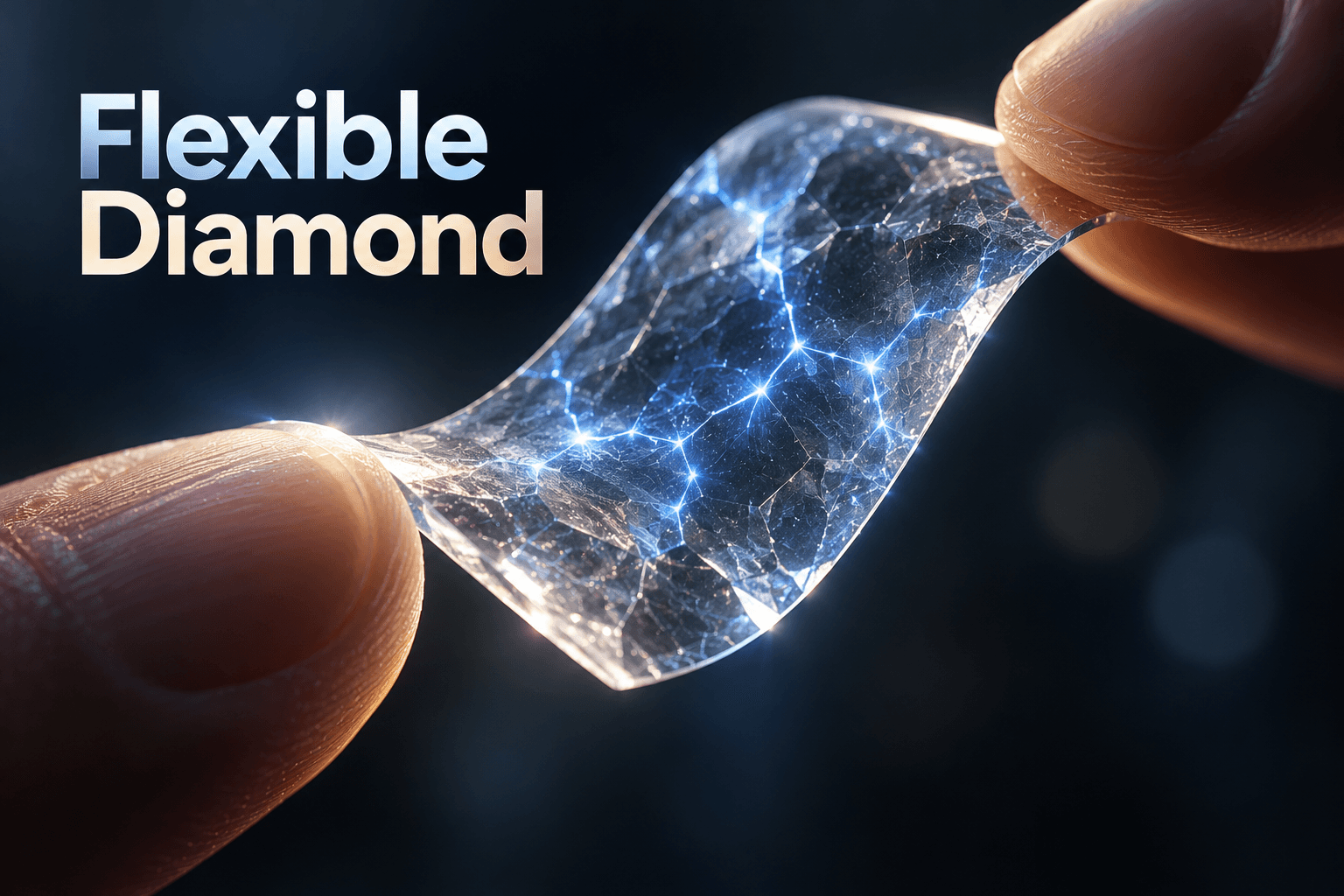
The sheet of diamond was so thin it drooped under its own weight, like a strip of cling film lifted off the roll. A researcher pressed it into a gentle curve and let go. On the bench, a voltmeter needle flicked, settled, flicked again with the next bend.
That flick was not supposed to exist. Since the early 1900s, physics textbooks have placed diamond firmly on the list of materials that cannot turn a squeeze into a spark. The reason was not a lack of trying. It was a rule about symmetry, and diamond seemed to follow that rule perfectly.
The lesson from the Hong Kong bench is quieter than "the textbook was wrong." Diamond's flawless core really does obey the rule. The researchers did not break it. They built a diamond out of its own flaws and used the flaws, and that changes what the hardest material we know is good for.
The Rule Diamond Always Obeyed
The effect in question is called piezoelectricity, from the Greek for "pressure." Jacques and Pierre Curie discovered it in 1880 when they pressed on a quartz crystal and measured a voltage appear across its faces. Bend certain crystals and they generate electricity; feed those crystals electricity and they flex. It is one of the most useful two-way streets in physics.
You rely on it constantly. The timekeeping crystal in a quartz watch is a sliver of piezoelectric quartz, kept humming at a steady frequency by a trickle of current. The clicker in a barbecue lighter snaps a tiny hammer against a piezoelectric crystal to throw a spark. The same principle helps steady the atomic-clock signals behind how GPS knows exactly where you are.
Whether a crystal can do this at all comes down to one geometric question: does its atomic lattice have a center of symmetry? Picture the atoms as a repeating grid of positive and negative charges. In a lattice with a center of symmetry, every shove of a positive charge in one direction is mirrored by an identical shove in the opposite direction, and the two cancel. No net charge builds up. Squeeze it all you like; nothing comes out.
Diamond is the poster child for that kind of balance. Each carbon atom sits at the center of a perfect tetrahedron of four identical neighbors, the whole structure as evenly weighted as a well-made dice tower. Its lattice has a center of symmetry, so the textbook answer was simple: diamond is not piezoelectric, end of discussion. For over a century, engineers used diamond in tiny mechanical devices only as a stiff, inert stage for other materials to perform on.
Did You Know?
The piezoelectric effect is probably touching your skin right now. Beyond watches and lighters, thin piezoelectric films sit inside phone speakers, ultrasound probes, inkjet printer heads, sonar arrays, and the haptic buzzers that make a screen feel like it clicked. It took more than 40 years after the Curies' discovery for the first practical quartz oscillator to appear, in the early 1920s. The gap between a lab curiosity and a shipped product is often measured in decades.
Making Diamond Bend
To catch diamond breaking the rule, the Hong Kong group first had to make diamond do something it normally refuses to do: bend.
Bulk diamond is famously unyielding. But thinness changes everything about how a stiff material behaves. A ceramic dinner plate shatters if you flex it, yet a ceramic coating a few atoms thick will wrap around a curved surface without complaint.
The team, led by Zhiqin Chu and Yuan Lin, built on a technique the same group reported in 2024 called edge exfoliation. The idea borrows from the trick that first isolated graphene: press adhesive against the exposed edge of a diamond and peel, lifting away a sheet far thinner than anything a saw or polisher could produce. Done carefully, it yields membranes across a two-inch wafer, smoother than a millionth of a millimeter and thin enough to fold back on themselves. For this study the films ran between roughly one and twenty micrometers thick, a fraction of the width of a human hair, and could be bent into a visible arc and spring back thousands of times over.
Crucially, these films were polycrystalline. Instead of one continuous crystal, each membrane is a mosaic of many small diamond grains packed together at slightly different angles, like a dry-stone wall built from countless irregular blocks. That mosaic structure turns out to be the whole point.
Where the Rule Breaks
Run the symmetry argument again, but this time look at the seams.
Inside any single diamond grain, the lattice is still perfectly balanced and still generates nothing. At a grain boundary, though, two mismatched crystals meet along a jagged interface. The atoms crowded into that seam are not arranged symmetrically, because they are compromising between two different orientations. The neat cancellation that silences the crystal interior simply does not happen there.
Bend the membrane and those lopsided boundary regions distort unevenly. Charge piles up along the seams, more on one side than the other, and because the seams thread through the whole film, the imbalance adds up into a measurable voltage between the top and bottom faces. First-principles calculations backed this up: the researchers found a non-symmetric shift in electrical polarization that appeared only in polycrystalline diamond and vanished in a perfect single crystal, staying tightly concentrated near the boundaries.
So the century-old rule was never broken. A flawless diamond still cannot do this. The team just built a diamond made mostly of flaws and wired the flaws together.
By the research team's own measurements, a five-micrometer membrane produced roughly 70 millivolts when bent at about one percent strain, and kept working through 7,000 bending cycles. On one standard measure of how efficiently a material converts stress into usable voltage, the diamond films scored higher than aluminum nitride, gallium nitride, and the industry-standard ceramic known as PZT. These figures come from a single research group's first report and await independent replication, but the direction is striking: the material long dismissed as a non-starter outperformed the incumbents on that metric.
What a Powered Diamond Could Do
A voltage that small will not charge anything. Its value is as a signal, or as a trickle for a device that barely sips power.
That is where diamond's other properties start to matter. It is biocompatible, so the body tends to tolerate it rather than attack it. It is chemically inert, shrugging off acids and salt water. It handles heat and radiation that would degrade a conventional piezoelectric ceramic. A material that generates its own tiny electrical signal when it deforms, and can also survive being implanted or planted somewhere brutal, is a genuinely new tool.
The uses researchers point to follow from that combination. A pressure sensor sealed inside the body that never needs a battery swap. A strain gauge on a turbine blade or a bridge cable that reports its own flexing. Diamond has spent a century as the tough, silent scaffolding inside other people's devices. It may be about to start doing some of the talking, though the honest caveat is that this is one lab result with tiny voltages, and the road from bench to product usually runs for years.
Knowlegic Perspective
It is worth noticing how often "impossible" in science turns out to mean "impossible in the clean version." The symmetry rule that ruled out diamond is real and still stands. What the rule quietly assumed was a perfect crystal, and almost nothing in the physical world is a perfect crystal. Real materials are full of boundaries, dislocations, and mismatched grains, and those imperfections are not random noise. They have their own structure, and that structure can have its own physics.
The broader shift here is in how engineers regard defects. For most of the history of materials science, a grain boundary was a weakness to be minimized, a place where things crack and corrode. Treating those same boundaries as the working part of a device, the bit you design around rather than design out, is a different mindset. It suggests other textbook "cannots" might be hiding a similar loophole.
A sheet of diamond thin enough to bend was flexed in a Hong Kong lab, and a voltmeter twitched, something 120 years of textbooks said could not happen. The researchers did not break the rule. They built a diamond out of its own flaws and used the flaws.
Sources & References
- Uncovering piezoelectric effect in polycrystalline diamond membranes, Science Advances (2026)
- Piezoelectric effect in polycrystalline diamond membranes (open-access full text), PubMed Central (2026)
- HKU researchers discover piezoelectric effect in diamond membranes, challenging century-old scientific dogma, The University of Hong Kong (2026)
- Piezoelectric effect in diamond membranes challenges century-old scientific dogma, Phys.org (2026)
- Scientists discover diamonds can generate electricity, ScienceDaily (2026)
- Scalable production of ultraflat and ultraflexible diamond membrane, Nature (2024)
- Piezoelectricity, an overview, ScienceDirect Topics / Elsevier (2023)
Enjoyed this?
Get notified when a new Knowlegic story worth knowing is published.


