

Two Human Species Walked the Same Mudflat, Days Apart
Fossil footprints on a Kenyan lakeshore caught two different kinds of human crossing the same ground within days of each other, 1.5 million years ago.
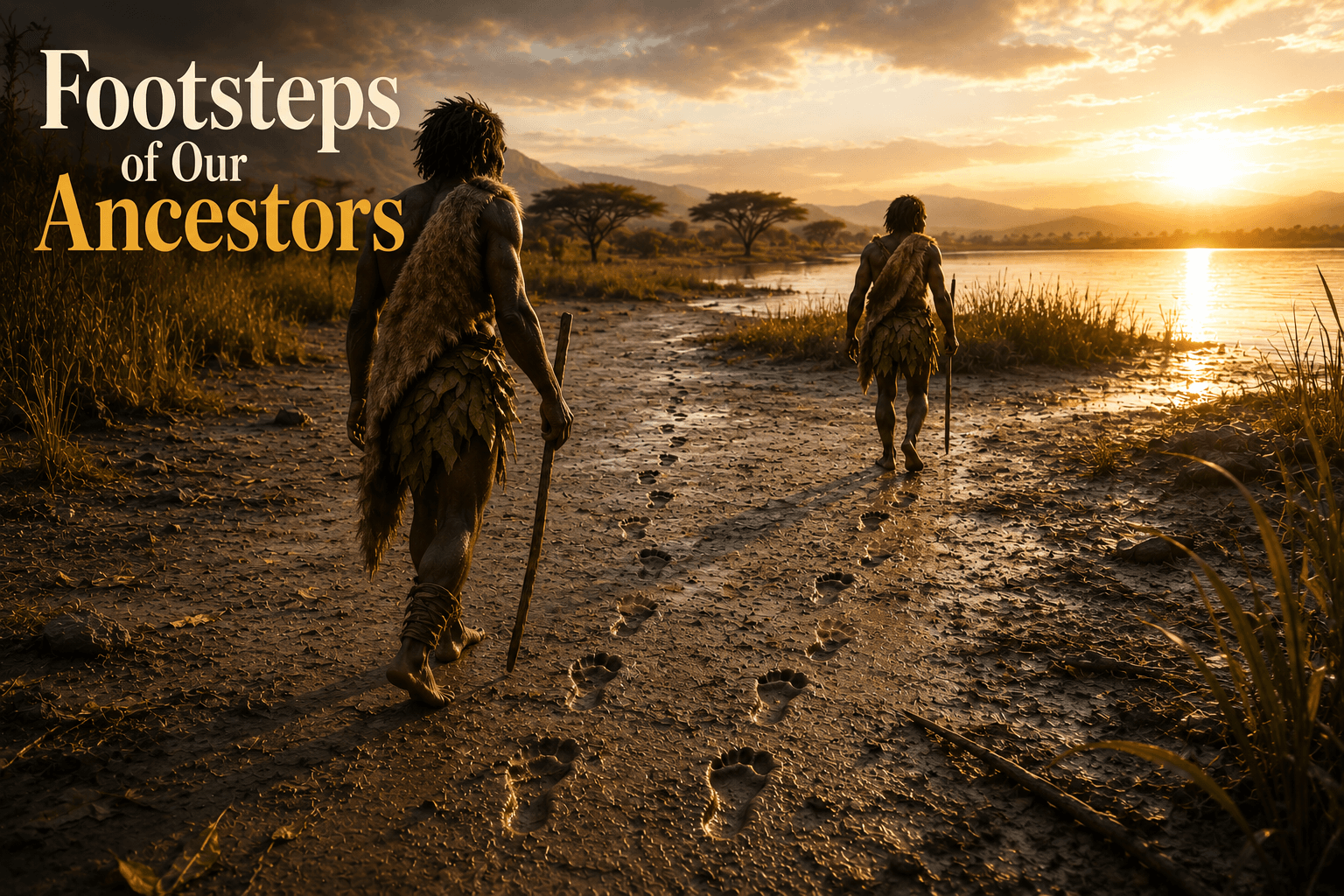
For a few hours, two different kinds of human may have shared the same stretch of mud.
About 1.5 million years ago, on the shore of what is now Kenya’s Lake Turkana, one hominin walked across wet sediment, leaving a trail of footprints behind. Another species passed through the same place soon after, close enough in time that the mud had barely changed.
Then the shoreline disappeared beneath layers of sediment.
The footprints stayed buried until researchers uncovered them in 2021.
What they found was extraordinary: two different human relatives had walked across the same landscape within hours to days of one another.
Human evolution was never a single line, with one species replacing another in neat succession. It was a crowded landscape, with different kinds of humans sharing the same world and sometimes, perhaps, the same path.
The Mudflat That Kept a Week
The site sits in the Koobi Fora region on the eastern side of Lake Turkana, a stretch of northern Kenya that has produced more early human fossils than almost anywhere on Earth.
A team led by Kevin Hatala of Chatham University began excavating in July 2021 and cleared an area about the size of a small bedroom. In it they found a continuous trackway of a dozen footprints walking in a line, almost certainly one individual, plus three isolated prints left by three others moving across the same surface.
The timing is the striking part. Freshly exposed mud cracks and curls as it dries. These prints show none of that damage, which means the surface was buried quickly and everyone who walked across it did so within a window of hours to days.
The human tracks were not alone. The same surface held prints from birds, from horse-like animals, and from large-bodied grazers, the ordinary foot traffic of a watering place. The lakeshore functioned like a stop on a long highway, somewhere many different animals passed through for water, including more than one kind of human.
Did You Know?
Footprints are rare in a way bones are not. A skeleton can wait millions of years inside rock; a footprint needs the mud to be exactly the right softness, then needs gentle burial within days, then needs an erosion cycle that re-exposes it just as scientists are looking. Only a handful of early hominin track sites exist anywhere in the world. The oldest, at Laetoli in Tanzania, is about 3.6 million years old and shows an upright walker long before large brains evolved.
Reading Two Gaits From the Same Ground
A bone tells you what a body was built like. A footprint tells you what a body was doing.
The researchers scanned every print with 3D imaging and compared the shapes: the depth of the arch, the angle of the big toe, how weight rolled from heel to push-off. The lone trackway showed a flatter foot and a big toe that angled outward and stayed mobile, more like a chimpanzee's grip than a modern human's rigid lever. The isolated prints showed a stiffer arch and a toe held in line with the foot, the mechanics of a walker much like us.
From that, the team assigned the long trackway to Paranthropus boisei and the scattered prints to Homo erectus. The same lakeshore, the same few days, two feet that worked in noticeably different ways.
The prints carry more than identity. A footprint's length scales roughly with the length of the foot that made it, and its depth reflects how much weight came down on the mud. Feeding those measurements through models built on modern people lets researchers estimate how tall and how heavy the walkers were, which is how the 2026 study arrived at its surprising size numbers. This is the kind of forensic reading of a compressed moment that also let researchers show Pompeii was not buried in a single day, where the sequence of ash layers rewrote the timeline.
Who They Were
Homo erectus is the ancestor-shaped one. From the neck down its body was close to ours, built for long-distance walking and running. It made stone tools, likely used fire, spread out of Africa across Asia, and survived for more than a million years after these prints were laid.
We know that body unusually well because of a discovery on the other side of the same lake. In 1984, a fossil hunter working with Richard Leakey's team found the skeleton now called Turkana Boy, a young Homo erectus male who died around 1.5 million years ago and was already close to five and a half feet tall. It remains the most complete early human skeleton ever recovered, and it came out of the ground within a day's drive of the footprint site.
Paranthropus boisei was a different experiment in being human. Its brain stayed small, but its jaw and chewing muscles were enormous, built around molars roughly the size of a thumbnail. Nicknamed "Nutcracker Man," it lived on tough, low-quality plant food, mostly grasses and sedges. It vanished within a couple hundred thousand years of leaving these tracks, a short window in evolutionary terms.
Those different diets are probably why the two could share a shoreline at all. Ecologists call it niche partitioning: two species avoid a head-on fight for survival by making their livings in different ways. One hominin was an omnivore ranging widely for meat, tubers, and fruit; the other was a specialist grinding through tough plants nobody else bothered with. Chemical analysis of Paranthropus teeth backs this up, showing a diet dominated by the kind of grasses and sedges that grew right at the water's edge.
They may have competed at the margins, or ignored each other, or watched warily from across the reeds. The prints cannot say which.
A separate trackway a short distance away, reported in 2026, recorded eight Paranthropus boisei individuals moving together. Analysis of their prints put some of them near six feet tall and around 165 pounds, considerably larger than earlier fossil estimates suggested, with feet comparable in size to Homo erectus. The group appeared to be mostly adult males, with no small prints from females or juveniles. These figures come from a single team's analysis of one trackway, using body-size models built on modern people, and have not yet been tested against an independent find. The footprints were first spotted in 1978, with more of the surface uncovered in 2016 and 2023.
Why This Was Once Heresy
In the 1960s and 1970s, a serious school of thought held that there could only ever be one human species at a time. The reasoning borrowed from ecology: two species that use culture and tools the same way would compete so directly that one must always drive the other extinct. This "single species hypothesis" made human history a clean succession.
Fossil discoveries at Turkana and elsewhere had already strained that idea by the 1980s, turning up Paranthropus and early Homo in the same sediments. Most paleoanthropologists now picture a "bushy" tree with several hominin species overlapping for long stretches. What the footprints add is immediacy. Instead of two species in the same rough layer over thousands of years, here are two species on the same surface in the same week, close enough that one set of prints was still wet when the other was made.
Knowlegic Perspective
The instinct to draw human evolution as a ladder runs deep, probably because we are the only human species left and it is tempting to read the whole story as a road leading to us. The fossil record keeps refusing that shape. For most of the last few million years, being "human" meant being one of several kinds of human alive at once, with different bodies, different diets, and different ways of solving the same problems of walking, eating, and staying safe.
Our own recent past fits the pattern. Homo sapiens overlapped with Neanderthals and at least one other lineage as recently as 40,000 years ago, close enough to interbreed. The unusual situation is not that species coexisted. It is that today only one remains, which makes the branching history harder to see.
Two kinds of human used the same Kenyan shoreline within days of each other, 1.5 million years ago, leaving their footprints in the same stretch of ancient mud. The family tree has looked like a braided river ever since, and the single-file version was always a trick of standing at the one channel that still has water in it.
Sources & References
- Footprint evidence for locomotor diversity and shared habitats among early Pleistocene hominins, Science (2024)
- These two ancient human relatives crossed paths 1.5 million years ago, Nature (2024)
- Fossil footprints of different ancient humans found together for the first time, Natural History Museum, London (2024)
- Fossil footprints reveal that an ancient human relative was larger than previously thought and traveled in groups, Smithsonian Institution (2026)
Enjoyed this?
Get notified when a new Knowlegic story worth knowing is published.


